By Deborah Idowu
I didn’t always understand what “father” meant.
Until I started noticing what changed in a house when he was around, and what changed even more when he wasn’t. Before I ever understood him, I understood his effect: how the house shifted when he arrived, how it loosened when he left. That was my first definition of “father.”
In truth, fatherhood is not one story. It is a continent of stories. Some loud, some buried, some still unfolding in real time behind closed doors, in long work shifts, in hospital corridors, in quiet dining tables where one plate has remained untouched for years. And if we are honest, Father’s Day is not a celebration of one reality; it is a mirror. It reflects what we had, what we didn’t, what we lost, what we survived and what we are still trying to understand.
There are FATHERS who come home, and the atmosphere tightens before the door fully opens. Children scatter, not out of hatred necessarily, but out of distance. Emotional, relational distance. The sound of their footsteps is familiar, yet unfamiliar in comfort. The house learns how to adjust to silence even in their presence. In such homes, fatherhood becomes an authority before it becomes a relationship. Provision may exist, structure may exist, but connection feels like a language no one has fully learned to speak fluently.
There are FATHERS who never got the chance to become anything at all in the full sense of the word. They worked.
Not the kind of work that ends in applause or retirement speeches, but the kind that consumes mornings, stretches into nights, and still ends in insufficiency.
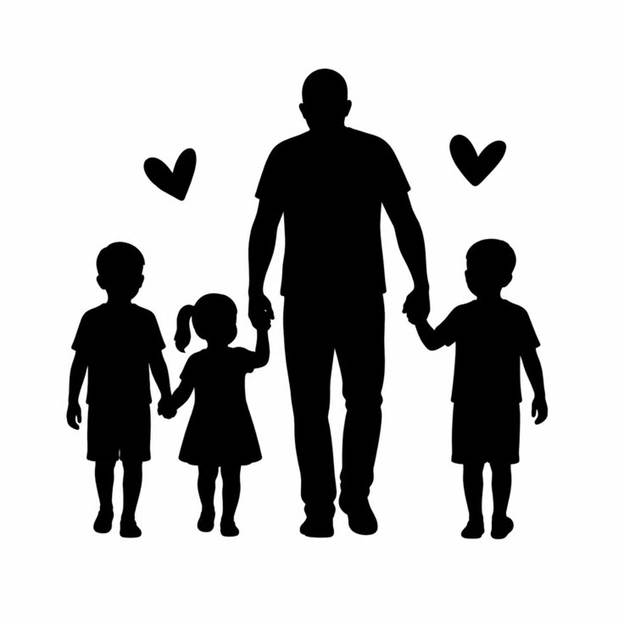
The kind where effort is abundant but reward is modest, and worst still, they leave early, before their children can truly understand what sacrifice means. Their legacy is not memory of conversation, but memory of absence filled with stories told by others. “Your father tried.” “He worked.” “Your father was a good man.” Words carrying weight, but not presence. Their children grow into adulthood trying to interpret a face they barely got time to know, trying to love a silhouette rather than a lived experience.
There are FATHERS who were never given ease in life themselves.
They grew up in hardship and inherited responsibility too early. And so, even when age begins to slow them down, life does not. They continue to work in bodies that are already asking for rest. Their peers retire into softness, quiet mornings and leisure, but they remain in motion. Not always because they want to, but because stopping feels like surrendering a battle still unpaid. Most times, their love is not always expressed in softness; it is expressed in endurance. And even that endurance is shaped by responsibility — by the quiet awareness of everything that depends on them. They give as much as they can: physically, financially, spiritually; again and again, showing up in ways that stretch them thin, not because it is never enough, but because there is always something that still needs to be held, carried, or done.
Then there are FATHERS who did not get to stay long enough to see the outcome of what they built.
They laboured, carried vision like a seed in their pockets, but life ended just when harvest season was near. Their children grow up into the fruits they never saw ripen. Those children succeed and feel a strange emptiness in victory. A seat remains unfilled in graduation halls, weddings, achievements, and milestones. The absence becomes a permanent guest in the room.
Then there are FATHERS whose bodies eventually become evidence of their sacrifices.
Years of labour show up later as illness, fatigue, weakened strength. Men who once carried entire households are now being carried by beds, by routines, by caregivers, by adjustments in family life. Their old age becomes a different chapter — less about building and more about enduring what building demanded. The irony is heavy: the same hands that raised families now need to be lifted. And yet, in many of them, dignity remains intact. Even in weakness, they still ask about their children before they ask about themselves.
There is also another category, fathers who had resources, yet walked away entirely. Provisions that never reached the homes it was meant for. Children growing up not just with absence, but with the awareness that something should be there, something that could have been present, but never was. It is a different kind of silence, one shaped not by circumstance, but by choice.
Sometimes they build another life elsewhere: another home, another family, another version of themselves that no longer includes the first. In that separation, the earlier children inherit gaps that time does not easily fill.
The numbers behind this silence are not small. Globally, nearly 1 in 4 children grew up without a father figure in 2025 alone; not because of death, not because of war or lack, but simply because a man decided that another life elsewhere mattered more. No explanation lands cleanly, and no presence returns to complete what remains unfinished. Only distance that becomes permanent.
And perhaps, for the sake of language itself, the name “father” feels too heavy for this category. For to place them under the same word as those who stayed, who tried, who showed up in spite of difficulty, it almost feels insulting to the meaning others fought to embody.
But even that is not the full picture, because there are FATHERS who are whole in ways that feel almost rare.
They are present — not occasionally, not partially, provide, and it is more than enough, show up, and they stay and not only carry responsibility; they share life.
In their homes, fatherhood transcends authority or provision alone and becomes a relationship in its full form. They participate in the everyday rhythms of their children’s lives, not as distant providers, but as active participants within them. They laugh easily, speak freely, and in those moments, hierarchy softens into companionship.
And as time passes, they do not burn out into silence or disappear into regret. They grow into old age with continuity intact, still known, still connected, still present in the lives they helped shape. There is a kind of fullness in them, where provision, presence, and love are not in conflict, but in harmony.
Even in this wide spectrum, there is an ache in society.
Motherhood is often centred, celebrated, photographed, and emotionally amplified, and rightfully so. It carries visible intensity, biological immediacy, and socially recognised sacrifice. On the other hand, fatherhood often moves differently. Less documented, less empathetically narrated and more assumed than examined. Many fathers exist in the background of family stories, present in impact but absent in the narrative spotlight.
This imbalance has created a strange cultural silence. Society expects fathers to be strong, but not necessarily expressive. Present, but not necessarily emotionally legible. Providers, but not always participants in emotional intimacy. And so, many fathers learn to love in ways that are practical rather than poetic: paying fees instead of speaking feelings, working overtime instead of sitting for conversations, showing love through provision rather than presence in words.
Still, fatherhood, across its many forms, is often a study in effort: effort to survive, to provide, to protect, to stay, to be better than what was inherited. Even when imperfect, even when incomplete, even when misunderstood.
Perhaps that is what makes Father’s Day a complicated reflection rather than a simple celebration. It refuses to sit inside one meaning. For some, it is gratitude; for others, grief. While for some, reconciliation; for others, unanswered questions that remain at the edge of memory. Even for many, it is all of these at once, held together without resolution, and there are those still waiting to hear “Daddy” for the first time.
So perhaps fatherhood is not one role after all, but a spectrum of becoming: a deeply human attempt to show up in a world that does not always teach men how to feel, but still demands they carry responsibility and love in ways that are often unspoken. The most honest way to frame it is this: a father defines himself not only by what he gives, but by how he exists in the emotional geography of his children’s lives—whether as presence, absence, memory, or becoming.
So, on this day and every day, here’s to the FATHERS who show up: in effort, in presence, in memory, and in becoming. The ones who have built, the ones still building, still carrying more than they say. In their many forms, they remain part of the story, and this is for YOU.