By Adebayo Balqees Folayemi
In 2024, Caleb Okegbemi came across an Instagram post by the Union of Campus Journalists (UCJ), University of Ibadan, spotlighting Adebayo Abdulrahman, who had recently served as the organisation’s Editor-in-Chief, after he was selected for the Don Lavoie Fellowship.
For Caleb, the post was more than an announcement about another student’s achievement. It introduced him to an opportunity he had not previously considered for himself.
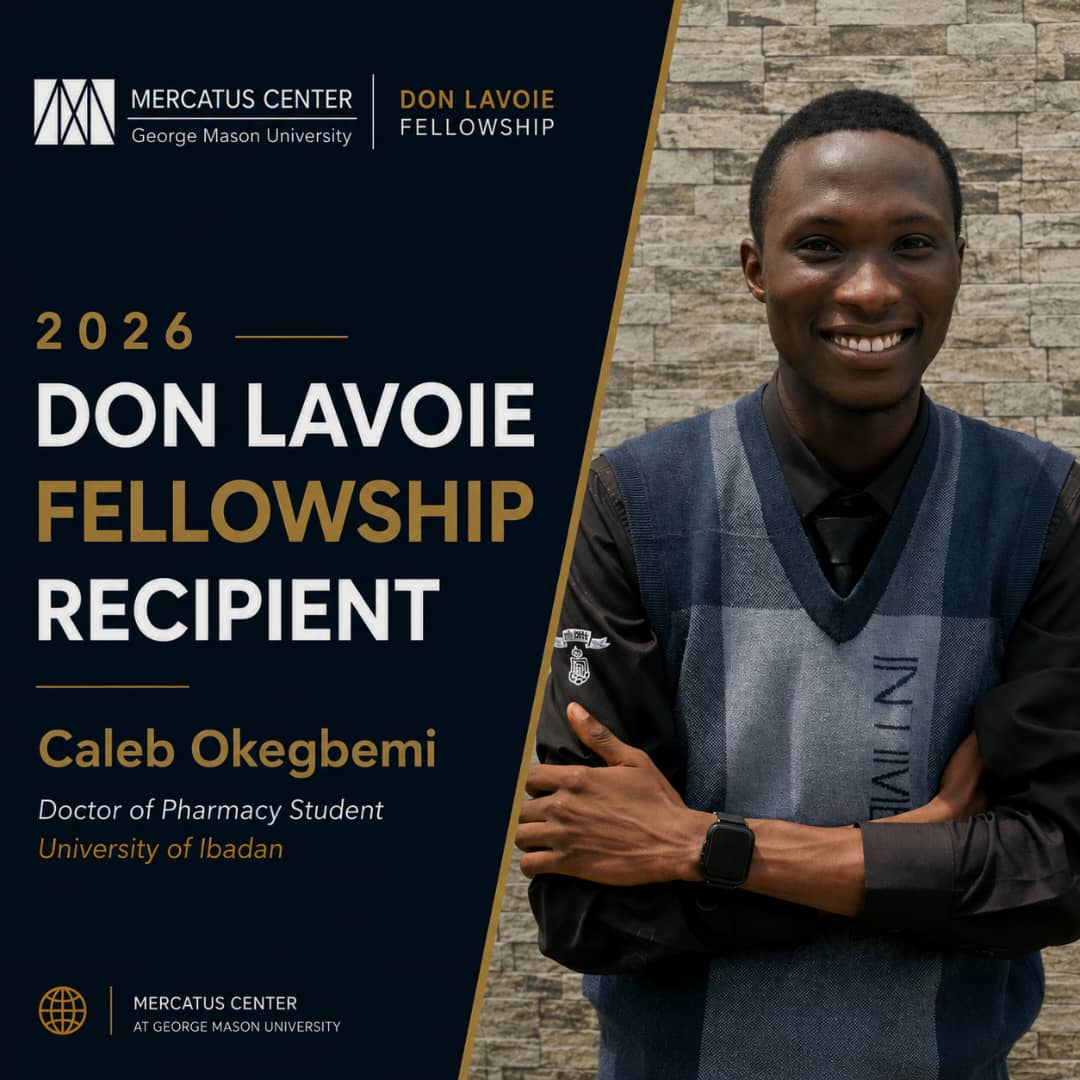
Two years later, Caleb, a Doctor of Pharmacy student at the University of Ibadan, was selected for the 2026–2027 Don Lavoie Fellowship, becoming the only undergraduate student from Nigeria in this year’s cohort and the second undergraduate from the University of Ibadan to receive the fellowship.
The Don Lavoie Fellowship, offered by the Mercatus Center at George Mason University in the United States, is an online, semester-long programme for students and young scholars interested in political economy and the ways institutions, markets, political systems and ideas shape society.
Recalling how he first encountered the fellowship, Caleb said the UCJ post caught his attention because it showed him that an undergraduate could engage with ideas beyond the traditional boundaries of his academic discipline.
“When I saw Adebayo Abdulrahman being selected for the fellowship, it made me believe that it was something I could actually secure too,” he said.

At the time, Caleb was already becoming interested in the relationship between pharmacy, public policy and healthcare systems. The fellowship’s focus on political economy, institutions and the ideas that shape society therefore offered an opportunity to broaden his understanding beyond the conventional scope of his discipline.
His first attempt, however, did not result in selection.
Caleb applied for the fellowship in 2025 but was unsuccessful. Rather than allowing the rejection to end his pursuit of the opportunity, he decided to try again.
“If someone CAN do it, I CAN also do it, and perhaps even do more,” he said.
He also recognised that the fellowship aligned with the kind of intellectual development he wanted and that one unsuccessful application did not mean he was incapable of being selected.
When he reapplied in 2026, he approached the process differently. He became more intentional about articulating his intellectual interests and connecting his experiences to the focus of the fellowship.
He reflected on how his pharmaceutical knowledge, experience founding ICANSTUDENT, and interest in public policy and healthcare systems had shaped the questions he wanted to explore. He also sought guidance from previous Don Lavoie Fellows.
Having gone through the process once before, he said it helped him understand the application better and approach his second attempt with greater clarity and intentionality.
His eventual selection placed him among the 2026–2027 cohort as the only undergraduate student selected from Nigeria. It also made him the second undergraduate student from the University of Ibadan to receive the fellowship, following Abdulrahman’s selection in 2024.
For Caleb, the opportunity extends beyond the financial award attached to the fellowship. The programme provides a total award of up to $1,250, including a stipend and required readings for online events. Fellows also receive advice on research, jobs and graduate school.
However, Caleb said he is particularly interested in the intellectual resources, guidance and community the fellowship provides.
As a pharmacy student, he hopes to develop a deeper understanding of how policies, incentives and institutions influence healthcare systems, pharmaceutical innovation and access to medicines.
He also looks forward to engaging with people from different academic backgrounds, having his ideas challenged and learning how others approach complex questions about society and institutions.
What began with a UCJ post about another University of Ibadan student’s achievement has now become Caleb’s own opportunity. His experience of discovering the fellowship, facing rejection and eventually earning a place in the 2026–2027 cohort offers a simple reminder: sometimes, the first step to an opportunity is simply knowing it exists.