
The Literary and Debating Society, University of Ibadan (TLDS’UI), has declared the Faculty of Law Literary and Debating Society winner of the JAW WAR 2026 semi-final against the Faculty of Education following a reassessment of the scores. This resolution has been rejected by the Education Literary and Debating Society (ELDS).
The resolution, dated Sunday, September 27, followed a request by the Faculty of Law Literary and Debating Society for a reassessment of the September 16 semi-final.
TLDS’UI said the review identified a 13-point outlier in the score sheet for the impromptu round, and that removing the score resulted in another tie.
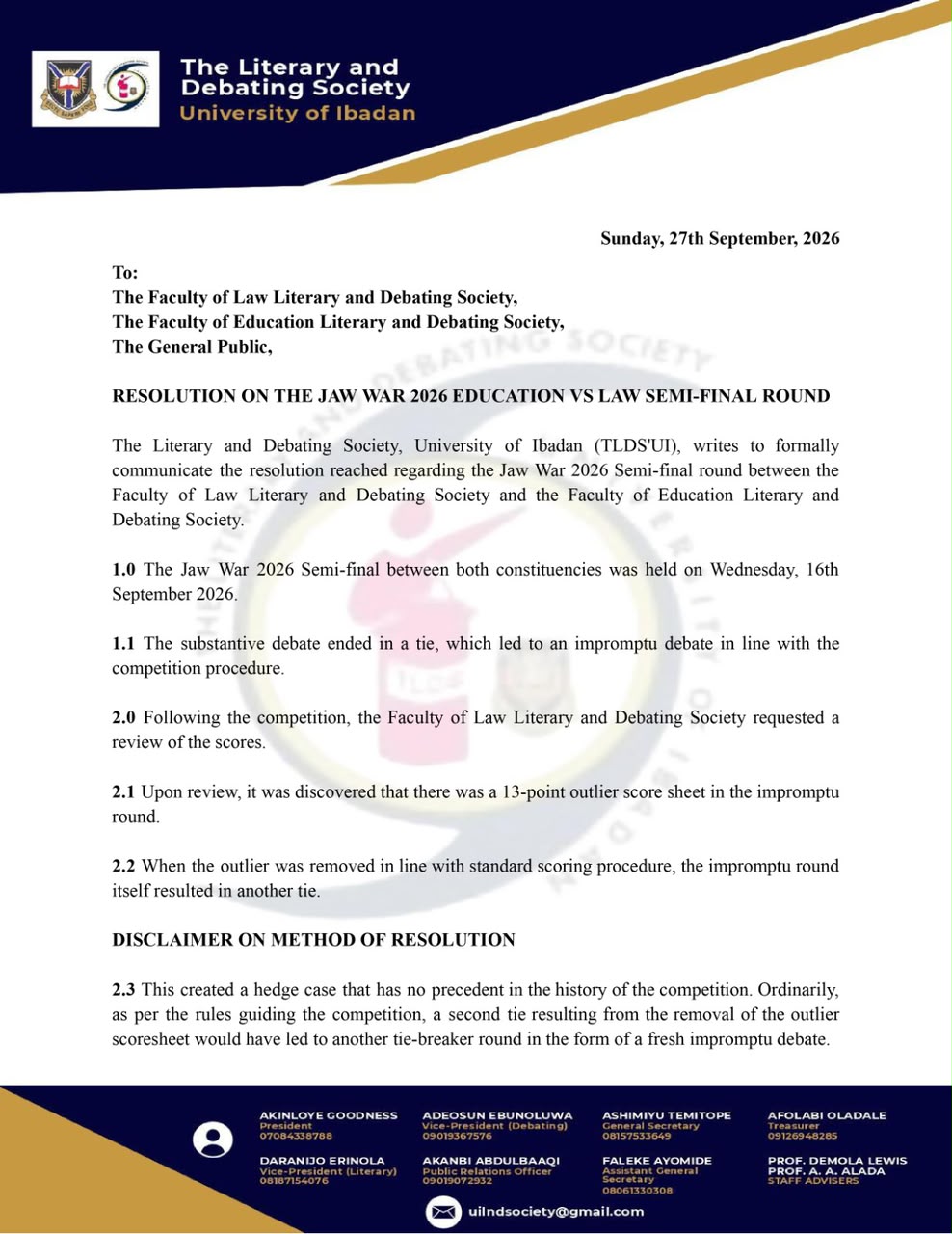
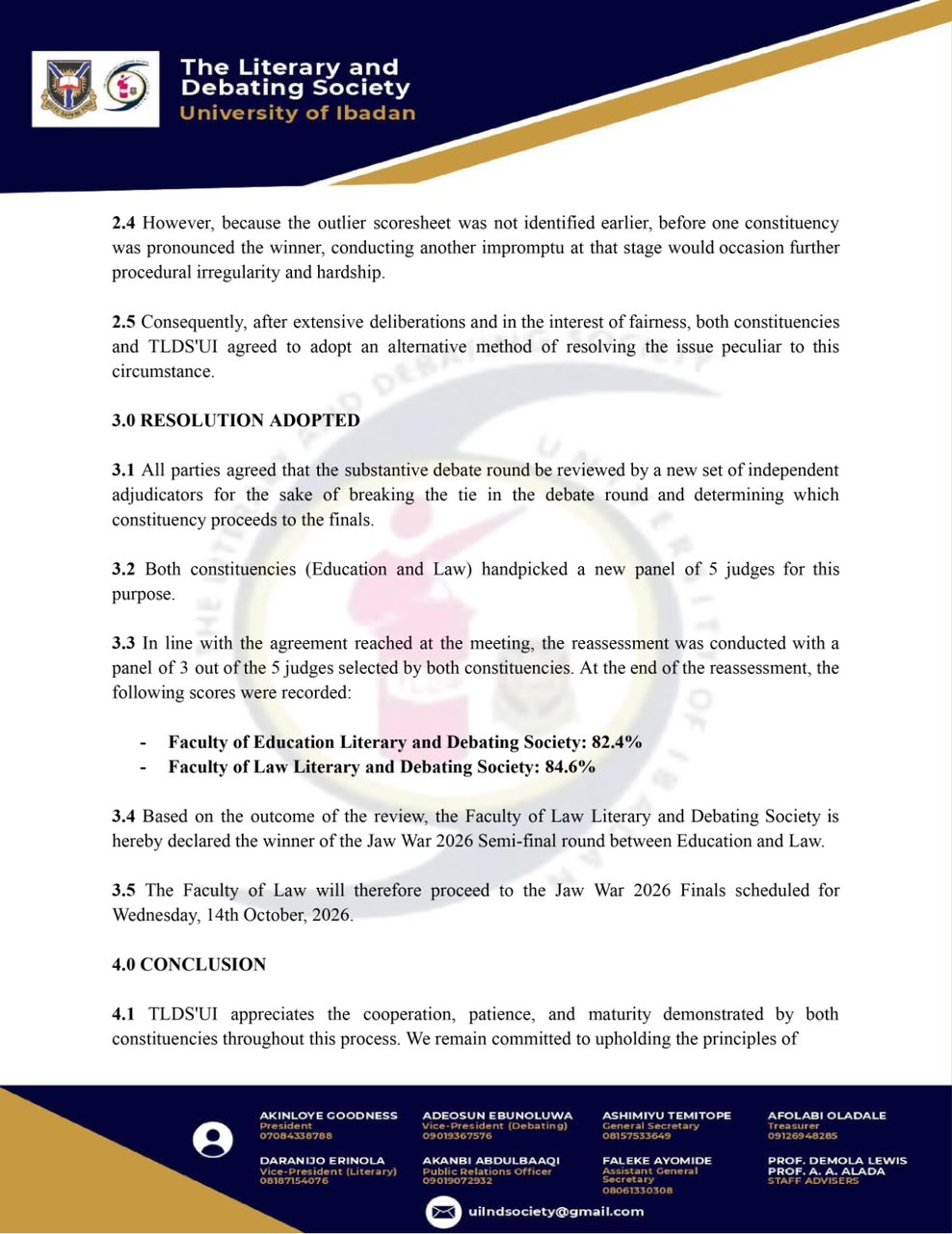
According to TLDS’UI, the substantive debate had initially ended in a tie, after which an impromptu debate was conducted in accordance with the competition’s procedures.
The society stated that, following the identification of the scoring outlier, the usual procedure would have required another impromptu round to break the tie.
TLDS’UI, however, said holding another round after one faculty had already been announced winner could create further procedural difficulties.
It stated that both faculties and the society subsequently agreed to an alternative resolution under which a new five-member panel was selected, with three judges conducting the reassessment.
The reassessment produced a score of 84.6 per cent for Law and 82.4 per cent for Education. Based on those scores, TLDS’UI declared Law the winner of the semi-final and stated that the faculty would proceed to the JAW WAR 2026 final scheduled for Wednesday, October 14.
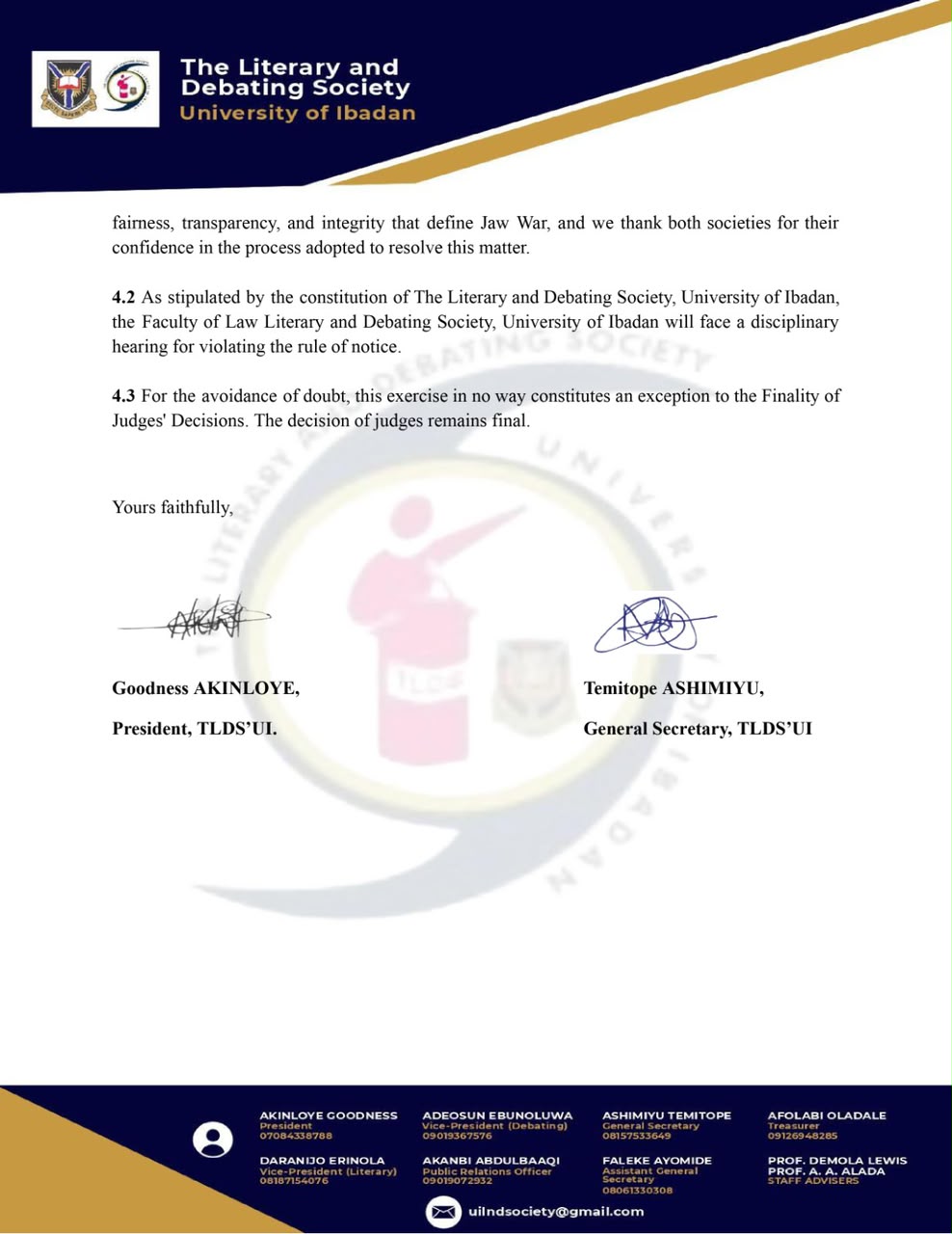
The resolution also stated that the Faculty of Law would face a disciplinary hearing for violating the society’s notice rule, as stipulated in its constitution.
TLDS’UI maintained that the resolution did not constitute an exception to the finality of judges’ decisions, reaffirming that judges’ decisions remain final.
ELDS response
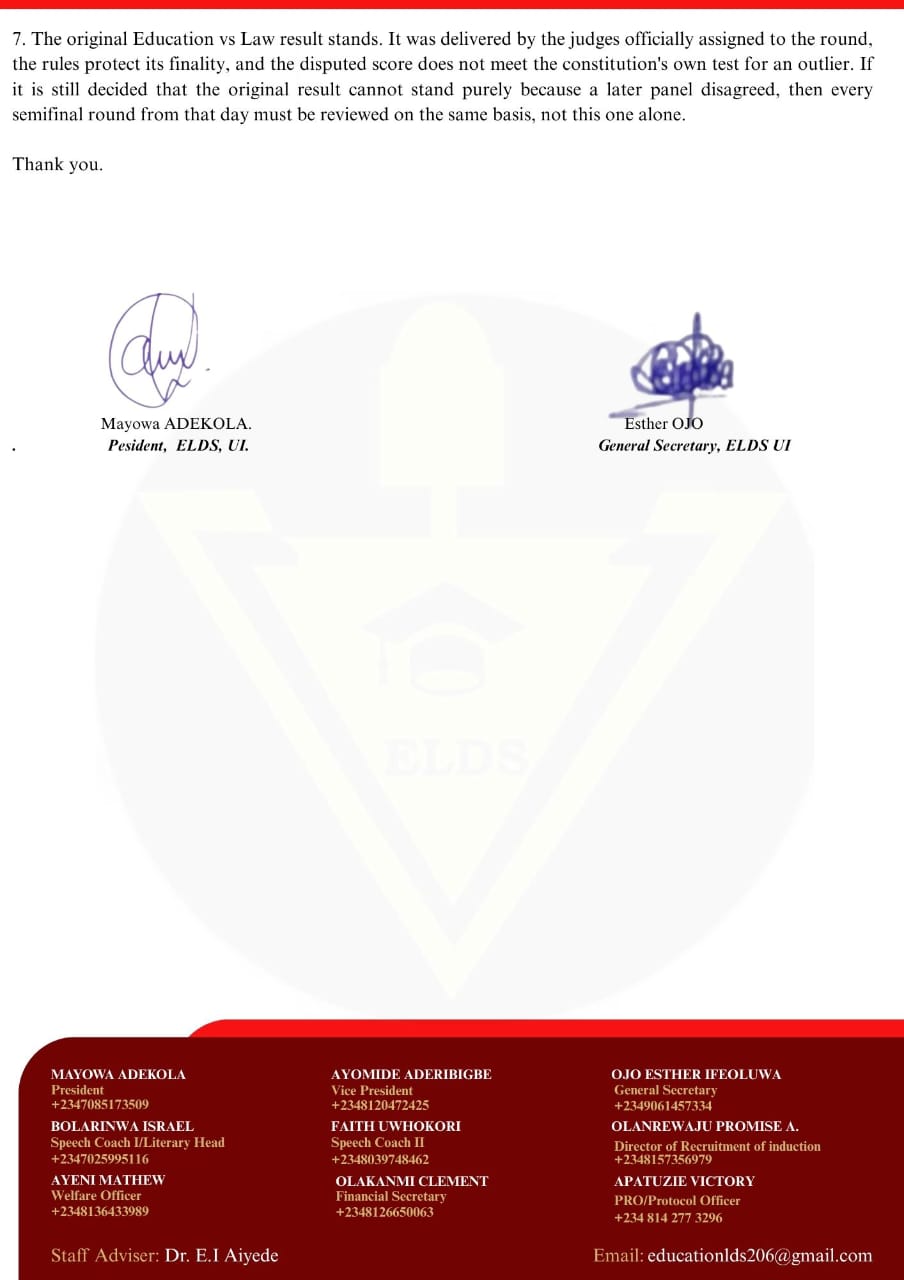
ELDS, however, rejected the resolution in a seven-point statement addressed to TLDS’UI on the same day. The society maintained that the original result declared by the judges assigned to the semi-final should remain valid.
ELDS said it participated in the reassessment process in good faith but argued that its participation did not amount to accepting the authority of a subsequent panel to overturn the original result.
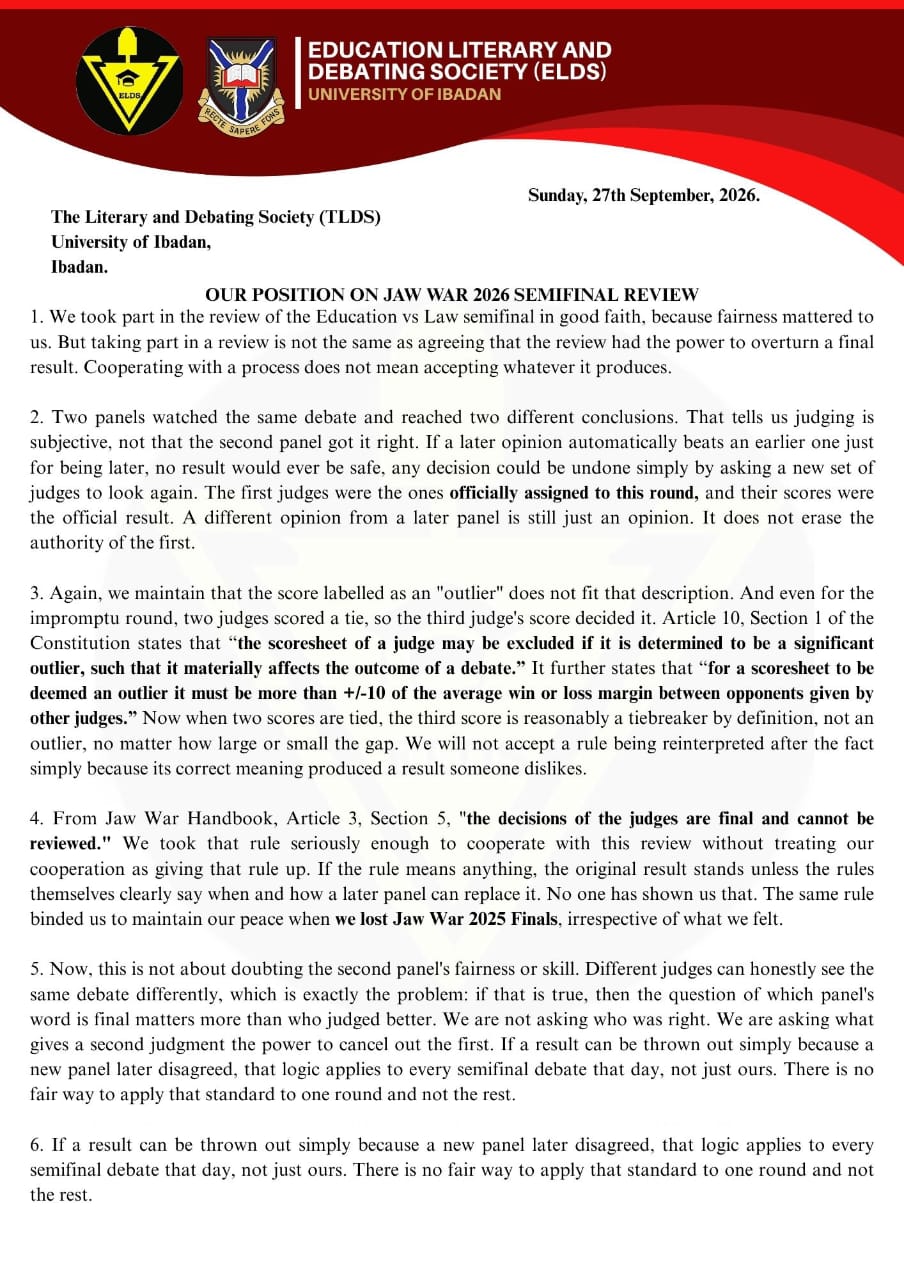
According to the society, the original panel was officially assigned to the semi-final, and its scores constituted the official result.
The society also challenged the classification of one of the judges’ scores as an “outlier”. It argued that the disputed score did not meet the criteria for an outlier under Article 10, Section 1 of the JAW WAR Constitution.
ELDS further stated that two judges had scored the debate as a tie, making the third judge’s score a tiebreaker rather than an outlier. It also cited Article 3, Section 5 of the JAW WAR Handbook, which, according to the society, provides that judges’ decisions are final and cannot be reviewed.
The society said the provision had previously been respected, including after its loss in the JAW WAR 2025 final, and questioned the basis for applying a different standard to the Education-Law semi-final.
ELDS clarified that its position was not intended to question the competence or fairness of the second panel, but rather the authority of a subsequent panel to cancel an earlier official result.
How it started
The development followed the Faculty of Law Literary and Debating Society’s initial request for reassessment on September 17.
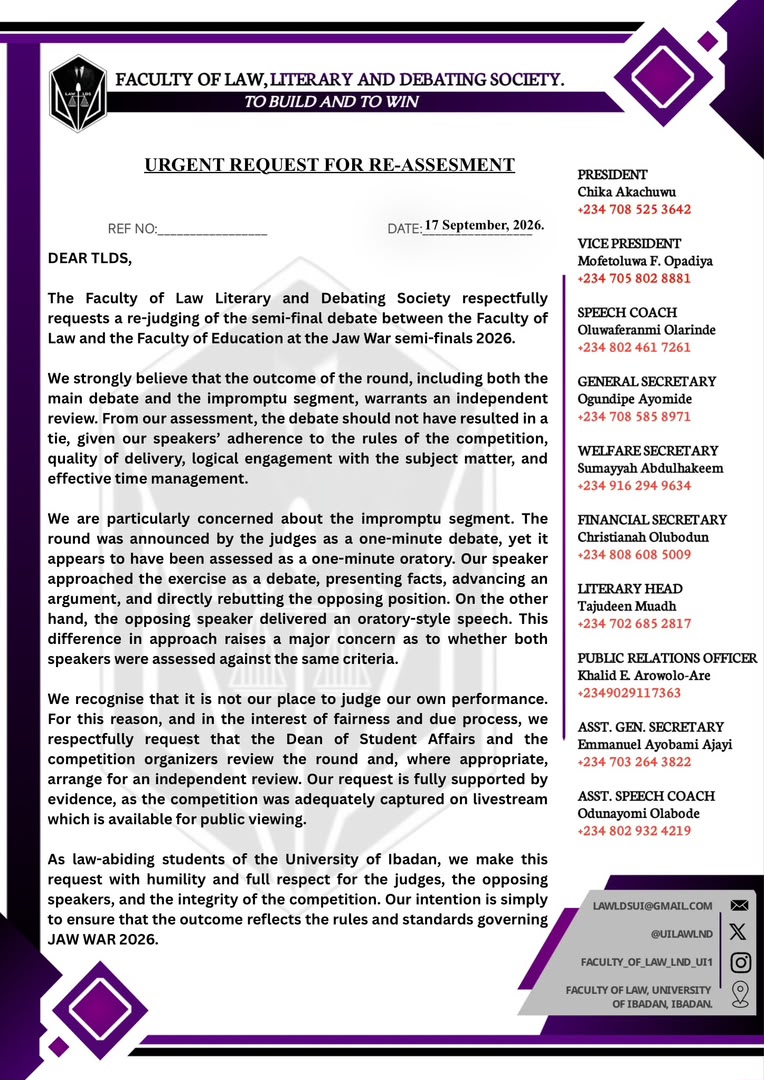
In its letter to TLDS’UI, Law L&D raised concerns about the scoring of both the main debate and the impromptu segment, particularly whether the impromptu exercise had been assessed according to the same criteria for both speakers.
The society said the exercise had been announced as a one-minute debate and argued that its speaker approached it as a debate by presenting facts, developing an argument and responding to the opposing position, while, according to Law L&D, the Education speaker adopted an oratory-style approach.
Law L&D consequently requested an independent review of the round and pointed to the availability of livestream footage as a possible basis for assessing the proceedings. It said the request was intended to ensure that the outcome reflected the rules and standards governing JAW WAR 2026.
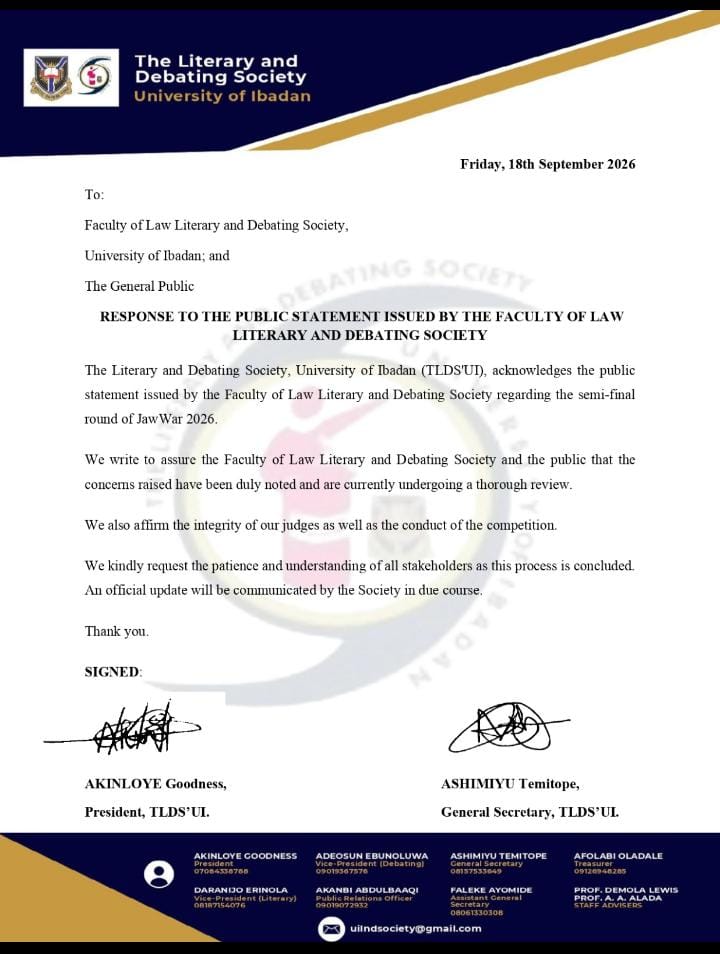
In a response dated September 18, TLDS’UI acknowledged the concerns raised by Law L&D and assured the society that the issues were undergoing review. Signed by the TLDS’UI President, Goodness Akinloye, and General Secretary, Temitope Ashimiyu, the response reaffirmed the society’s confidence in the integrity of the judges and the conduct of the competition while asking stakeholders to remain patient pending the outcome of the review.
NUESA further response a
The matter also drew a response from the Nigerian Universities Education Students’ Association, University of Ibadan (NUESA-UI), in a statement dated September 27. NUESA-UI questioned the basis and authority of the reassessment, arguing that the original semi-final had been concluded before the officially appointed panel of judges and that, following the applicable tie-breaking procedure, the Faculty of Education had emerged victorious.
NUESA-UI acknowledged that competitions could have mechanisms for addressing genuine irregularities but questioned whether a subsequent panel had the authority to replace the decision of the original judges. It referred to the JAW WAR Handbook, as cited by ELDS, which provides that judges’ decisions are final and cannot be reviewed.
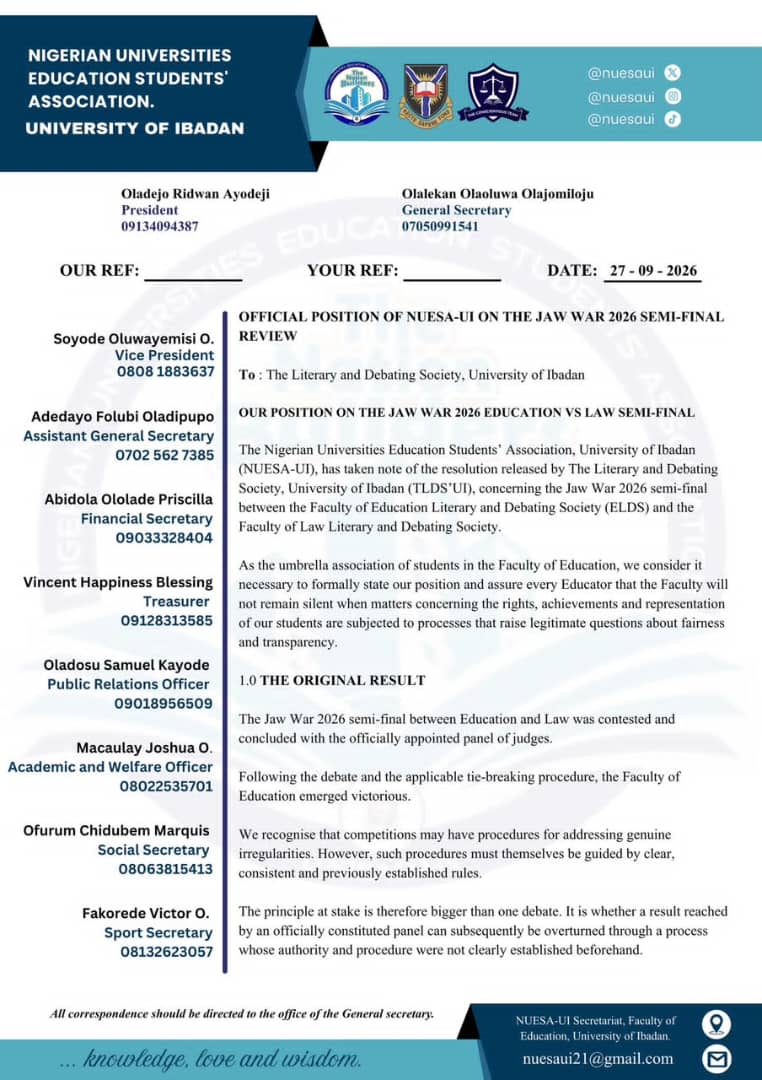
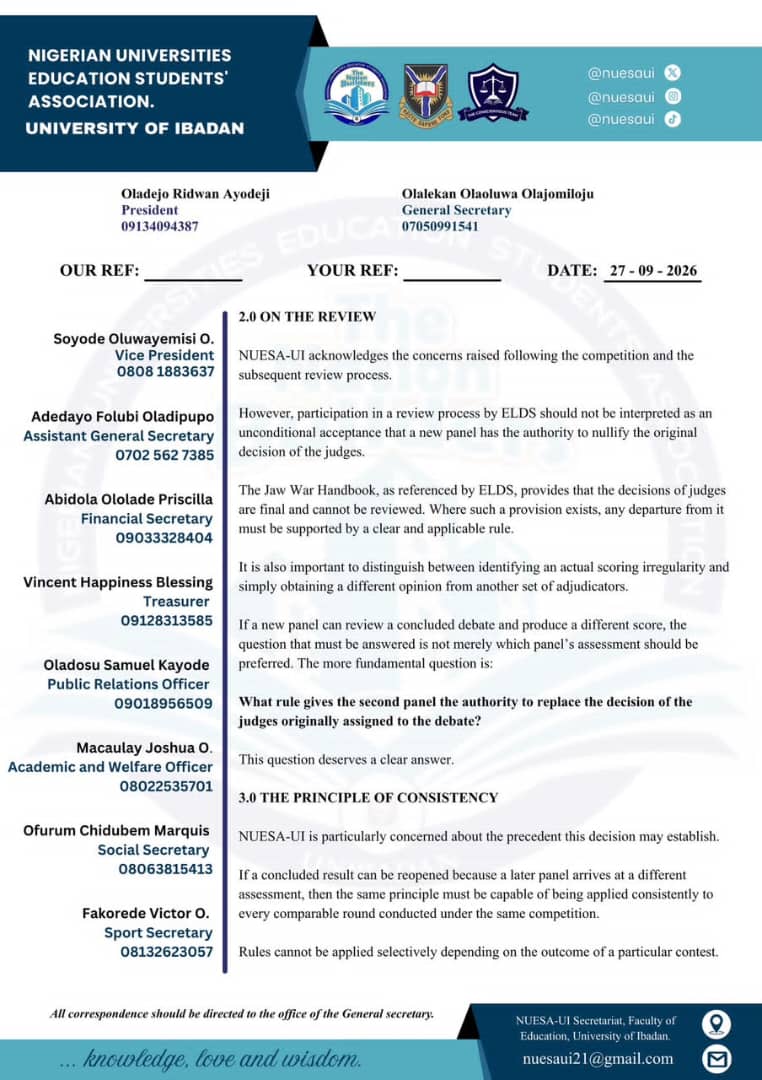
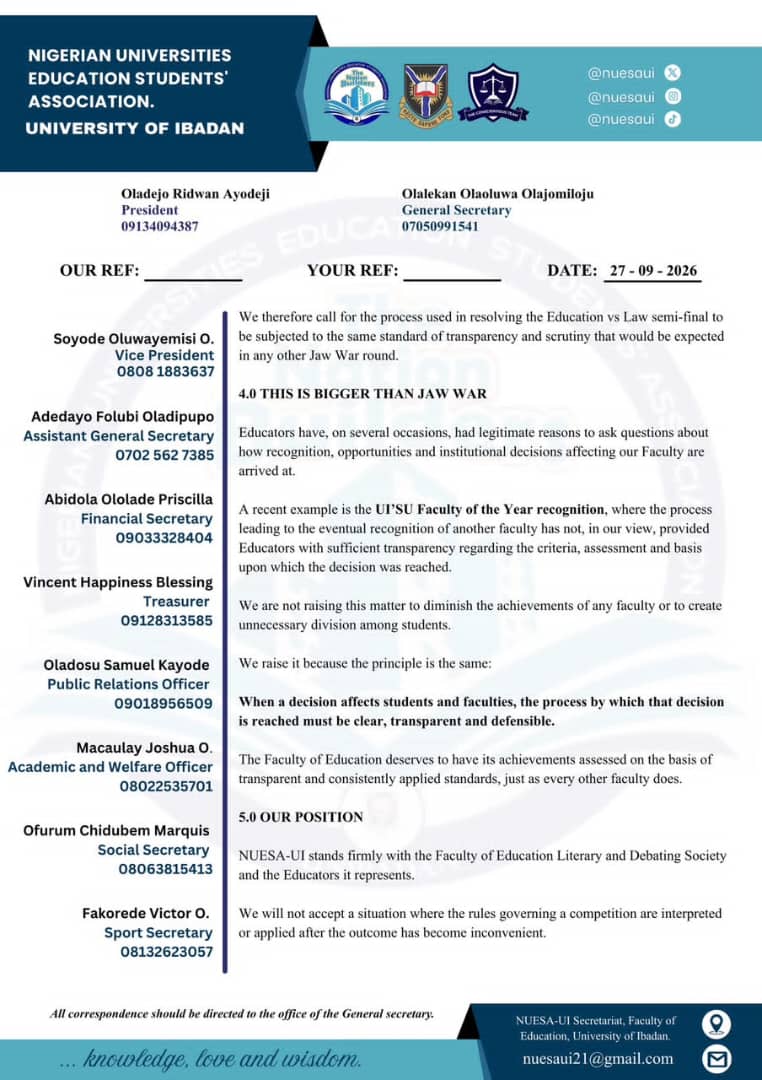
The association distinguished between identifying a scoring irregularity and obtaining a different assessment from another panel, questioning the specific rule that authorised a second panel to overturn or replace the original decision. It also raised concerns about the consistency of applying such a review mechanism to other rounds of the competition.
As of press time, TLDS’UI has declared the Faculty of Law winner of the semi-final and stated that it will proceed to the October 14 final, while ELDS has rejected the resolution and maintained that the original result should stand. NUESA-UI has also called for scrutiny of the process through which the reassessment was conducted.