By Adebayo Balqees Folayemi
The University of Ibadan has long been admired for its lush vegetation and tree-lined roads, which contribute to its reputation as one of Nigeria’s greenest campuses. Beyond their aesthetic appeal, trees improve air quality, support biodiversity, moderate temperatures, and enhance the campus environment. However, as many of these trees age, maintaining a balance between environmental conservation and public safety has become increasingly important.
Recent incidents involving fallen trees, alongside ongoing tree-felling exercises in parts of the campus, have drawn attention to the University’s approach to tree management.
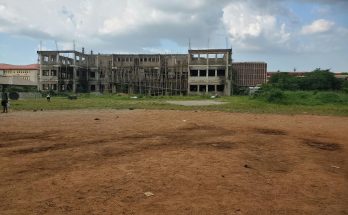
The renewed attention also comes about two years after trees at Heritage Park, opposite Queen Elizabeth II Hall of Residence, were felled for the construction of the ongoing Senate Building. This exercise drew environmental concerns from students, alumni, and other members of the University community. Against that backdrop, recent incidents of fallen trees and ongoing tree-felling exercises have once again brought campus tree management into focus.
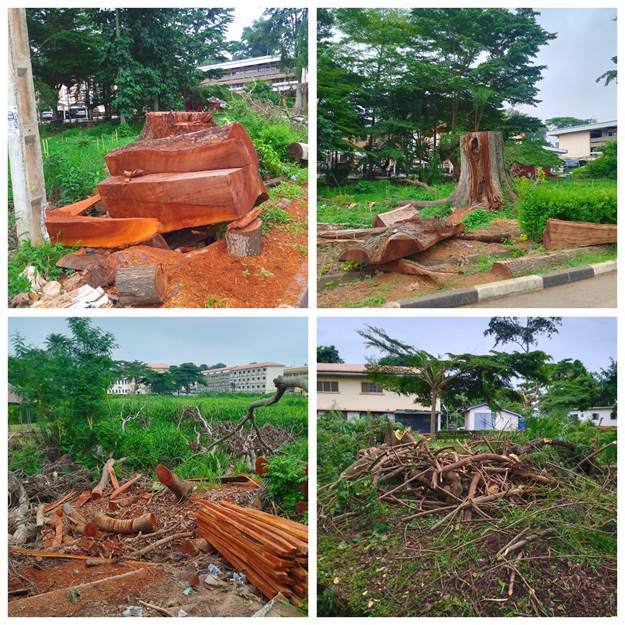
The tree-felling exercise is not limited to a single location. Across different parts of the University of Ibadan campus, trees have been removed or are being cut down. One such exercise was observed along Amina Way, where workers were felling trees and cutting the felled trunks into sections beside the road.
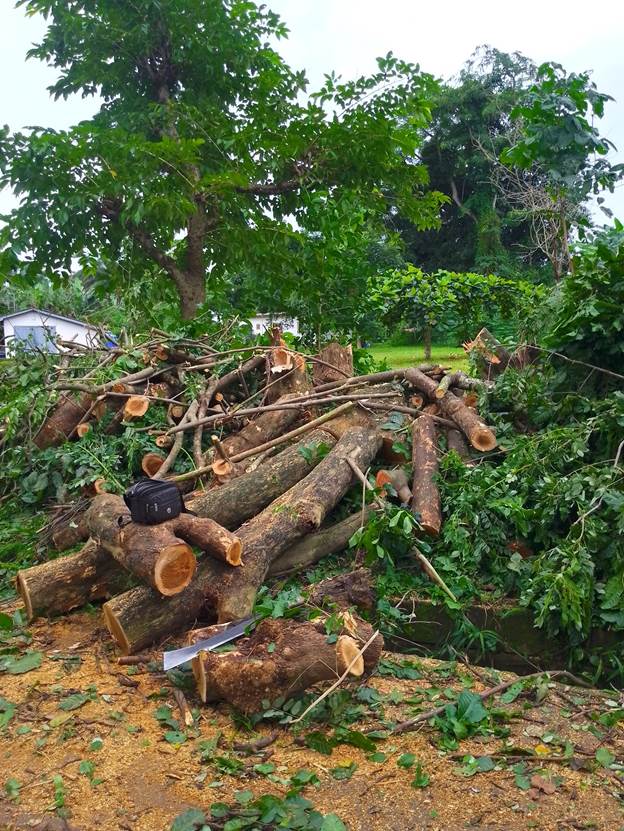
Speaking during an interview, Oluwaseun, a non-teaching staff member overseeing tree-felling operations, explained that the exercise was a preventive measure aimed at protecting lives and property.
According to him, several of the trees had become old, with weakened root systems and visible signs of instability. Some had begun leaning towards roads, while others had developed canopies stretching over major routes, increasing the likelihood of branches or entire trees falling unexpectedly.
“These trees can fall at any time,” he said, explaining that the decision to remove them is based on safety considerations rather than convenience.
He added that tree felling forms part of his routine responsibilities, particularly when trees are assessed to pose risks to motorists, pedestrians, and surrounding infrastructure.
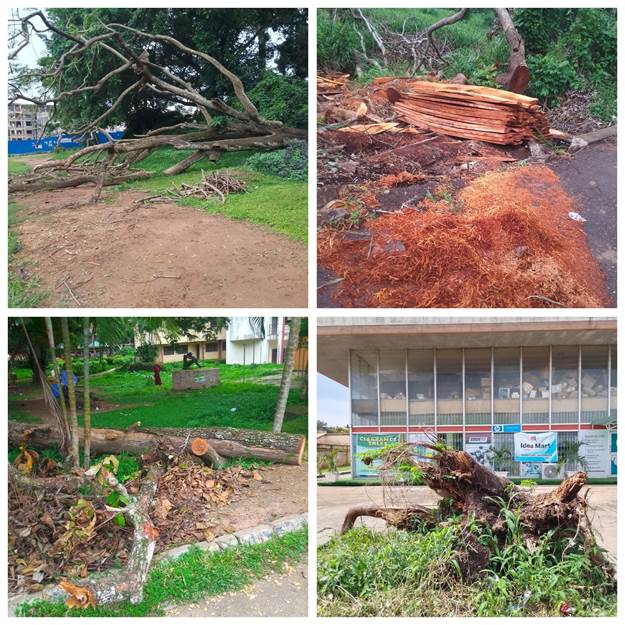
The recent incidents were evident in different parts of the campus. Beside the site of the ongoing Senate Building, a large tree lay uprooted close to a busy pedestrian route, with its roots exposed. Around the Faculty of Arts, another fallen tree was also observed with its roots exposed. Another incident was observed in front of the Faculty of Renewable Natural Resources, where teaching staff told the reporter that two trees had collapsed onto another tree, bringing all three down. Similar incidents have also been reported in other parts of the campus. While some of these incidents occurred after periods of heavy rainfall, the specific causes of each fallen tree could not be independently established.
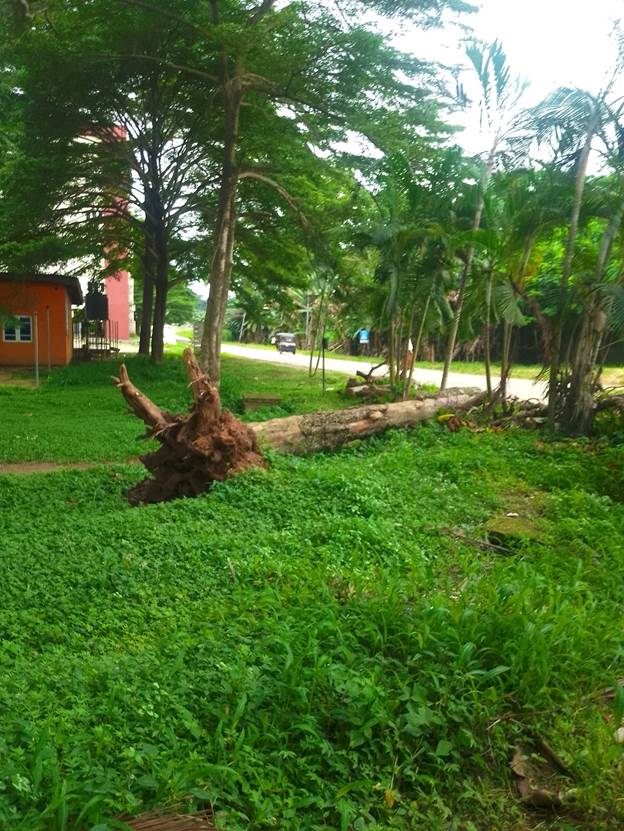
Around the Bookshop area, the remains of another tree, which had been cut into sections after it fell, marked the site where it had long provided shade for a sitting area frequently used by students. Speaking on the Bookshop incident, Oluwaseun explained that the tree was largely old and structurally weak. He added that there were no signs of heavy rainfall or strong winds when it collapsed, reinforcing his view that ageing and structural weakness were major contributing factors in that particular case.
Beyond ensuring public safety, the timber obtained from felled trees is put to different uses. Some of the wood was observed being processed into planks, while Oluwaseun explained that the timber is used for purposes such as house decking and pillars. He added that some are sold through approved University channels, with the proceeds paid into the University’s account. According to him, the timber is cut into different sizes to meet buyers’ needs, including those who use firewood for cooking.
Beyond the tree-felling exercise, another question is whether the trees being removed will be replaced.
According to Oluwaseun, discussions are ongoing about introducing new tree species to replace those removed. He noted that the proposed species would be selected with long-term safety in mind, particularly trees that are less likely to develop wide canopies over roads or pose hazards as they age.
Offering an expert perspective, Dr Fasoro of the Department of Social and Environmental Forestry explained that the recent incidents of fallen trees cannot be attributed to heavy rainfall or age alone. According to her, factors such as damaged root systems, pest infestation, diseases, and poor maintenance may also contribute to tree failure, highlighting the need for proper assessment and management.
She stressed that regular inspection and monitoring of trees are important for proper tree management. Dr Fasoro also recommended that the University adopt an urban tree management policy for proper campus tree management.
She further advocated a collaborative approach, noting that the University, staff, and students should come together to develop a campus tree management policy.
Ultimately, the conversation surrounding UI’s trees extends beyond those that have fallen or been felled. It raises broader questions about how a university celebrated for its rich vegetation can continue to preserve its natural heritage while adapting to the realities of ageing trees, expanding infrastructure, and public safety.
As development continues and environmental challenges evolve, the future of the University’s green landscape may depend not only on the decisions made today but also on the policies, expertise, and long-term commitment invested in managing its trees. Striking that balance will be essential to ensuring that future generations inherit a campus that remains both safe and environmentally sustainable.