
By Faith Ajewole
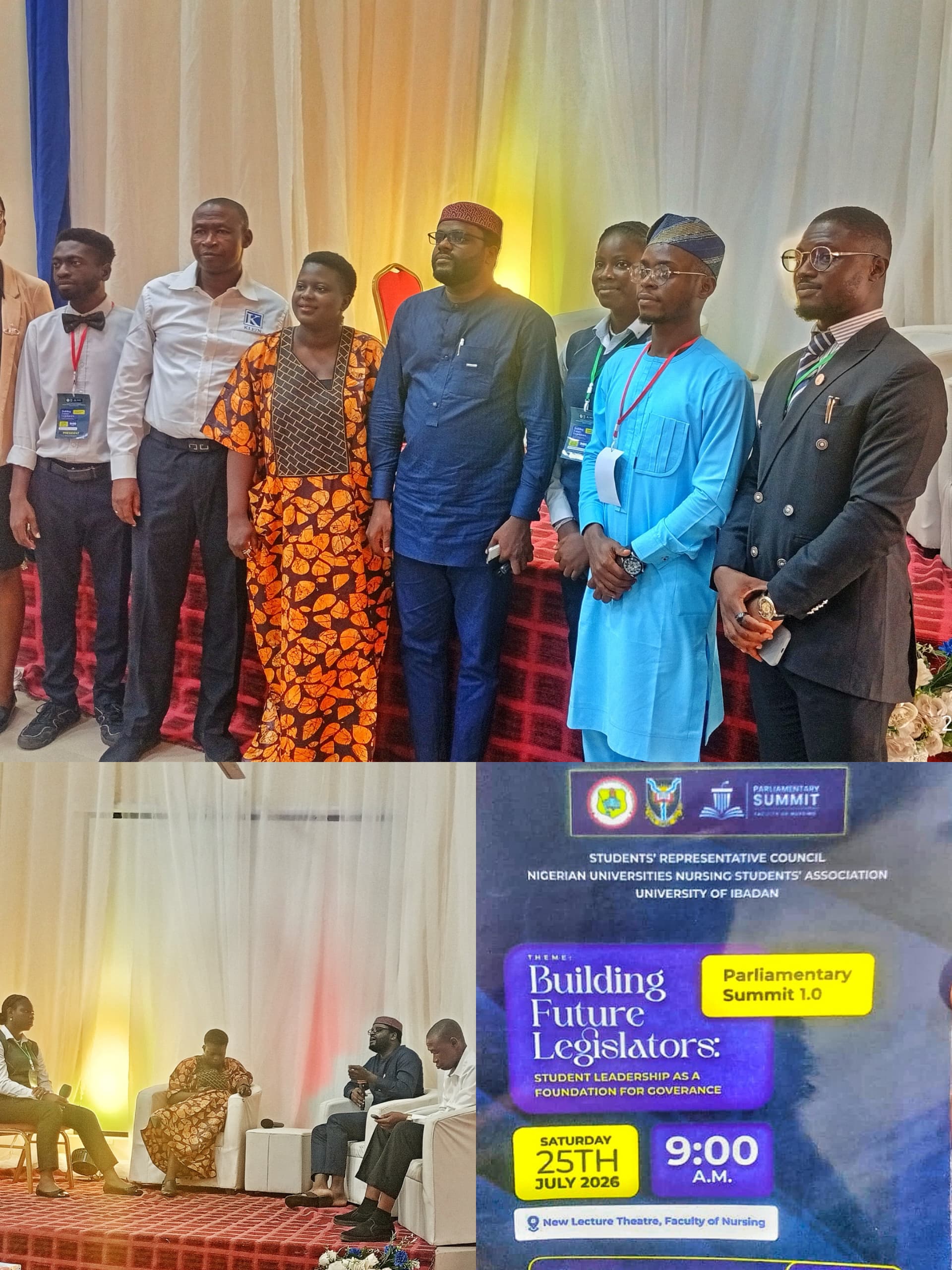
The Students’ Representative Council of the Nigerian Universities Nursing Students’ Association (NUNSA), University of Ibadan chapter, successfully hosted its maiden Parliamentary Summit 1.0 on Saturday, 25th July 2026, themed “Building Future Legislators: Student Leadership as a Foundation for Governance.” The summit brought together student leaders, faculty representatives and seasoned voices in student unionism for a day of reflection on leadership, advocacy and institutional governance within the student community.
The event opened with a goodwill message from Mrs Beatrice Adeoye, Director of Nursing Science at the Oyo State Ministry of Health, who set an encouraging tone for the day’s proceedings. Also present were the Dean of the Faculty of Nursing and representatives from the Students’ Representative Council, representing several constituencies across the university.
The high point of the summit was a panel session featuring three distinguished panellists: Rt. Hon. Israel Fawole, former Speaker of the Oyo State Youth Parliament; Mrs Temiloluwa Oyeniyi, founder of the Ibadan Local Government Development Managers’ Movement; and Comrade Nurse Adeleke Victor, Chairman of the National Association of Nurses and Midwives, Oyo State Council.
A key question put to the panel was how student unions and clubs could generate sustainable funding for their activities, and Comrade Adeleke Victor took the lead in responding, drawing on his own experience as a former student representative. He explained that many student clubs miss out on funding opportunities simply because they operate as unregistered, non-IGR (internally generated revenue) groups, and that once a general student club is formally registered as a recognised student organisation, it becomes eligible to apply for financial support, including grants disbursed by the undergraduate council to registered bodies and individuals under recognised student groups.
He also highlighted the value of establishing a Board of Trustees to court alumni and donor support, noting that transparent and well-documented financial structures build the confidence donors need to invest: “People, especially alumni, trust the organisation more when you can show accountability.”
He advised that unions maintain clear financial reporting, for instance, disclosing exactly how funds such as a stated per-head levy are spent, as this transparency reassures donors and trustees alike.
The panel session took a more spirited turn when the conversation shifted to student radicalism, particularly in light of recent confrontations involving the National Association of Nigerian Students (NANS). Asked whether radicalism is a good and advisable trait in student leadership, Mrs Temiloluwa Oyeniyi offered a measured perspective, noting that confrontation should not always be the default approach, even within unionism.
Rt. Hon. Israel Fawole, however, took a firmer stance, declaring his support for radicalism unequivocally. He was sharply critical of what he described as a culture of compromise within some student bodies, alleging that certain groups could be easily placated with token gestures, money or transport, rather than genuine engagement on substantive issues. Drawing from his own history of activism,
Fawole recounted his time as Osun State Coordinator in his first year, when he led a protest that NANS itself opposed, and referenced his involvement in founding the Campaign for the Education and Immediate Release of Student Activists (CERC), a coalition that included organisations such as the Joint Action Front (JAF), the Rights Movement, and the Nigeria Labour Congress (NLC) — but notably not NANS.
Turning to examples closer to home, Fawole cited the cases of student activists at the University of Ibadan, including Kunle Adebajo, Fisayo Soyombo, and Tunji Awojobi, recalling that when Kunle Adebajo was suspended, no protest was needed to secure his reinstatement, and that Tunji Awojobi’s detention by the Department of State Services was resolved through calm, deliberate engagement rather than public confrontation.
For Fawole, these examples illustrated that meaningful change can be achieved not only through street protest, but through dialogue, persistence and structured negotiation and that leaders must know when each approach is appropriate.
Following the panel discussion, the organisers presented awards to the panellists in recognition of their contributions to the summit, and the event was formally closed with a vote of thanks delivered by the President of the Faculty.