By TriadWrites
History was made again last week. Not in a studio, but in a comment section.
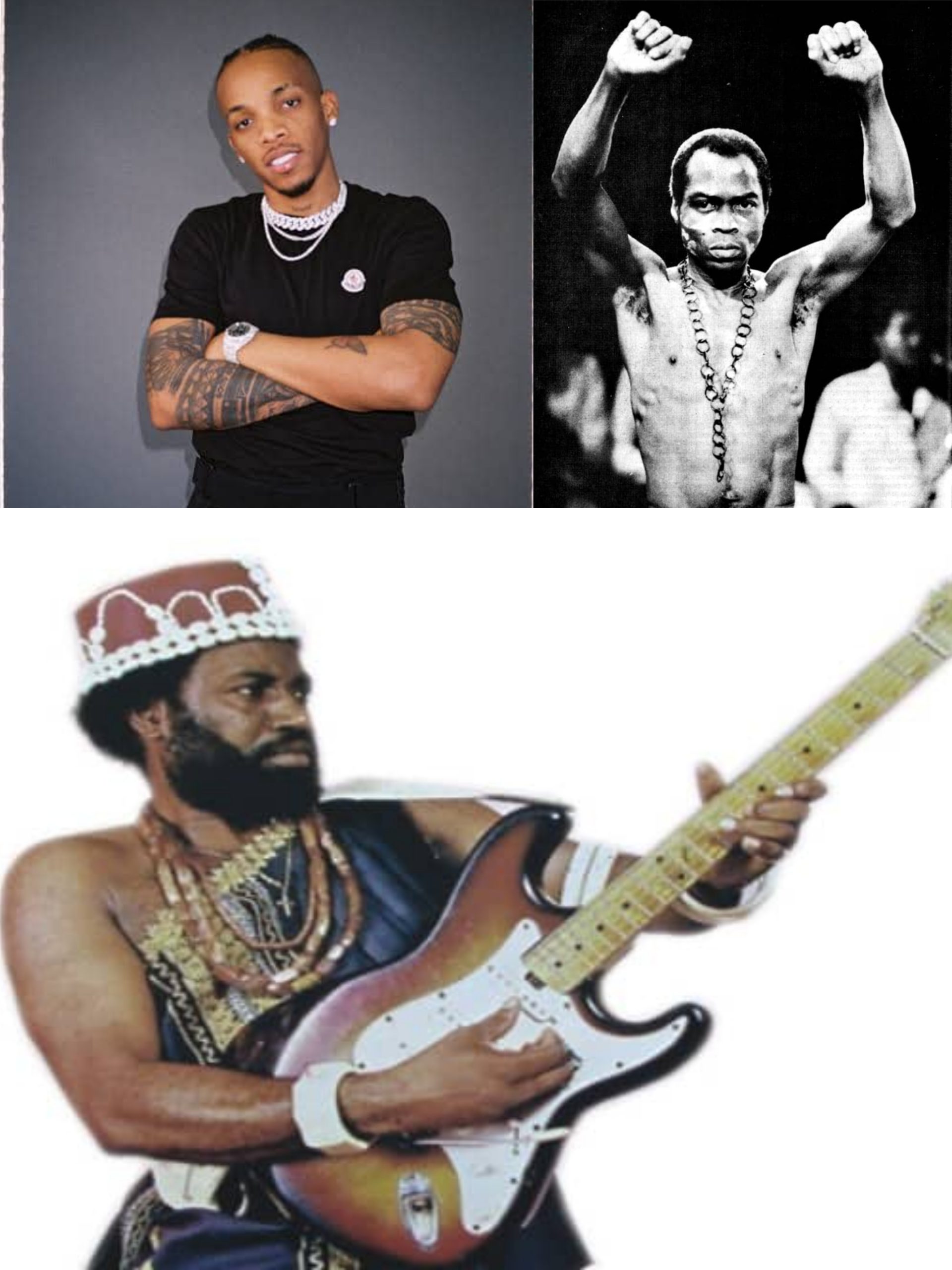
In late August 2026, on Hot 97 TV in New York, Nigerian star Tekno did the most dangerous thing an Afrobeats artist can do: he tried to give a history lesson on live radio. His summary? “Fela is not the originator of Afrobeats. Lagos people and Yorubas might say he is, but I am from the East, and we had legends like Oliver De Coque”. He acknowledged Fela’s massive contribution but said the global spotlight Fela got made everyone forget the rest of the village.
And boom, the internet, which is already a certified university of musicology, immediately enrolled 20 million new students. But before we start fighting over who owns what, let’s calmly break it down with actual dates before someone says Burna Boy invented drums.
The “S” That Causes Family Fights
First, there is one tiny letter that has been responsible for a surprisingly large percentage of this argument: S. This is where 90% of the argument fails its exam. Because before we start deciding who owns Afrobeats, we should probably establish which Afrobeats we are even talking about.
Afrobeat, without the S, was birthed in Nigeria in the late 1960s. Fela Kuti, alongside drummer Tony Allen, experimented with different contemporary sounds of the time and gradually developed the musical style that would become known as Afrobeat. Fela was the bandleader, while Tony Allen served as drummer and musical director of Africa 70 from 1968 to 1979. Fela himself said, “Without Tony Allen, there would be no Afrobeat.”And this was not exactly music designed for a three-minute attention span. Afrobeat came with 15-minute songs, 20 people on stage, enough brass to wake up your ancestors, and lyrics that could get you arrested. This one has parents. Two of them, and we know them.
But then, music did what music has always done: it moved. The sound travelled, other sounds entered the room, new artists began experimenting, and eventually another version of the name appeared and this time with an S.
Enter Afrobeats without introduction
Now, this is where the family tree gets complicated.
Afrobeats, with the S, emerged as an umbrella term that became popular in the early 2010s. And no, it was not born in Lagos. It was popularised in London. The music itself had already been cooking in Nigeria and Ghana from the late 1990s into the mid-2000s, drawing from highlife, hiplife, juju, fuji, hip-hop and other sounds. What the growing movement needed was a name that could fit all these different influences without forcing them into one neat little musical box.
British-Ghanaian DJ Abrantee helped popularise the term in the early 2010s and launched what has been described as the world’s first ever “Afrobeats” show on UK radio on April 11, 2011. And just like that, the S arrived. One little letter, suddenly carrying an entire continent’s musical luggage. It became an umbrella party bag for everything: highlife, hiplife, juju, fuji, hip-hop, everything. So, one is a genre. One is a giant family reunion. And arguing who invented the reunion is wild when you didn’t bring the food.
The Village That Cooked The Soup
And this is where Tekno’s argument starts making a little more sense. When he shouted out the East, he wasn’t necessarily trying to erase Fela. He was pointing at the bigger village behind the sound.
Because modern Afrobeats is a stew, and many people brought ingredients long before FL Studio existed. If we are tracing the ingredients, we have to go back to Ghana, where E.T. Mensah was already reigning as the King of Highlife in the 1950s. If highlife is the mother, he is the mother.
Then there is Oliver De Coque, born April 14, 1947, who started music in 1965 and blew up in the mid-70s. He became the frontman of Expo 76 Ogene Super Sounds, and the man had the kind of guitar that could make you forgive your ex. His debut, Messiah Messiah, dropped in 1977.
And Oliver was not alone in that Eastern sound. Chief Osita Osadebe was active from the 1950s till 2007, building a musical career so associated with his distinctive highlife sound that “Doctor of Hypertension music” somehow feels like an appropriate job title.
Then came Prince Nico Mbarga, the Nigerian-Cameroonian musician who gave us Sweet Mother in 1976, still Africa’s most loved mother song.
Meanwhile, elsewhere in Nigeria, King Sunny Ade and Chief Ebenezer Obey were carrying juju into the 70s and 80s, making talking drums speak English and proving once again that African music had no interest in respecting the borders we like to draw around genres.
And the ingredients did not stop there.
From Cameroon came Manu Dibango, whose Soul Makossa in 1972 gave us that sax hook that later taught Michael Jackson how to say “mama-se mama-sa”.
Different countries, different sounds and different generations, but still the same soup. None of them was trying to be “originators”. They were just trying to make people dance without electricity. And that is probably the part of the conversation we keep missing.
Music does not usually grow from one person’s backyard. Sounds travel, they borrow, they mix, and they evolve. One generation takes something from another and adds its own flavour. By the time Afrobeats became a global identity, the pot had been cooking for decades.
Kudos to Everyone Who Built The House We Are All Dancing In
So let’s be honest. The real winners are not the Twitter historians. It’s the playlist. Because every generation added something to this house.
Fela Kuti and Tony Allen gave us the blueprint. E.T. Mensah and the highlife pioneers laid down another part of the foundation. Oliver De Coque and Osadebe carried Eastern soul into the mix. King Sunny Ade and Ebenezer Obey pushed juju forward. Manu Dibango showed how far African sounds could travel.
Then came the bridge generation.
2Baba’s African Queen in 2004 proved we could export love songs. D’banj and Don Jazzy helped turn Afrobeats into a business plan.
And then the rooftop party started.
Wizkid, Davido, Burna Boy, Tiwa Savage, Sarkodie, Fuse ODG, Angelique Kidjo and many others took pieces of what had been built before them and pushed them onto a global stage. That 1960s brass, that 1970s guitar, those rhythms that had survived generations, they took them, reshaped them and turned them into global anthems in the 2010s and 2020s.
So no, Tekno did not say Fela is irrelevant. He said the house has more than one landlord. And he is right.
So, whether your heart secretly belongs to Fela’s politically-charged horns from 1968, or Oliver’s endless, smooth highlife guitar riffs from 1977, you are still dancing in the same house built by Nigerians, Ghanaians, Cameroonians and Beninese legends.
The history is longer than one name. The music is bigger than one sound. And the “S” probably doesn’t deserve this much trouble. Now, can we all go back to dancing and leave the origin story alone?
The music slaps regardless.