By Abdulraheem Akanbi Lawal
Dr Oladipo Kolawole Elijah, Chief Executive Officer of Helix Biogen Institute, has urged students and early-career researchers to look beyond academic requirements and consider how their research can address practical problems, attract funding and be commercialised.
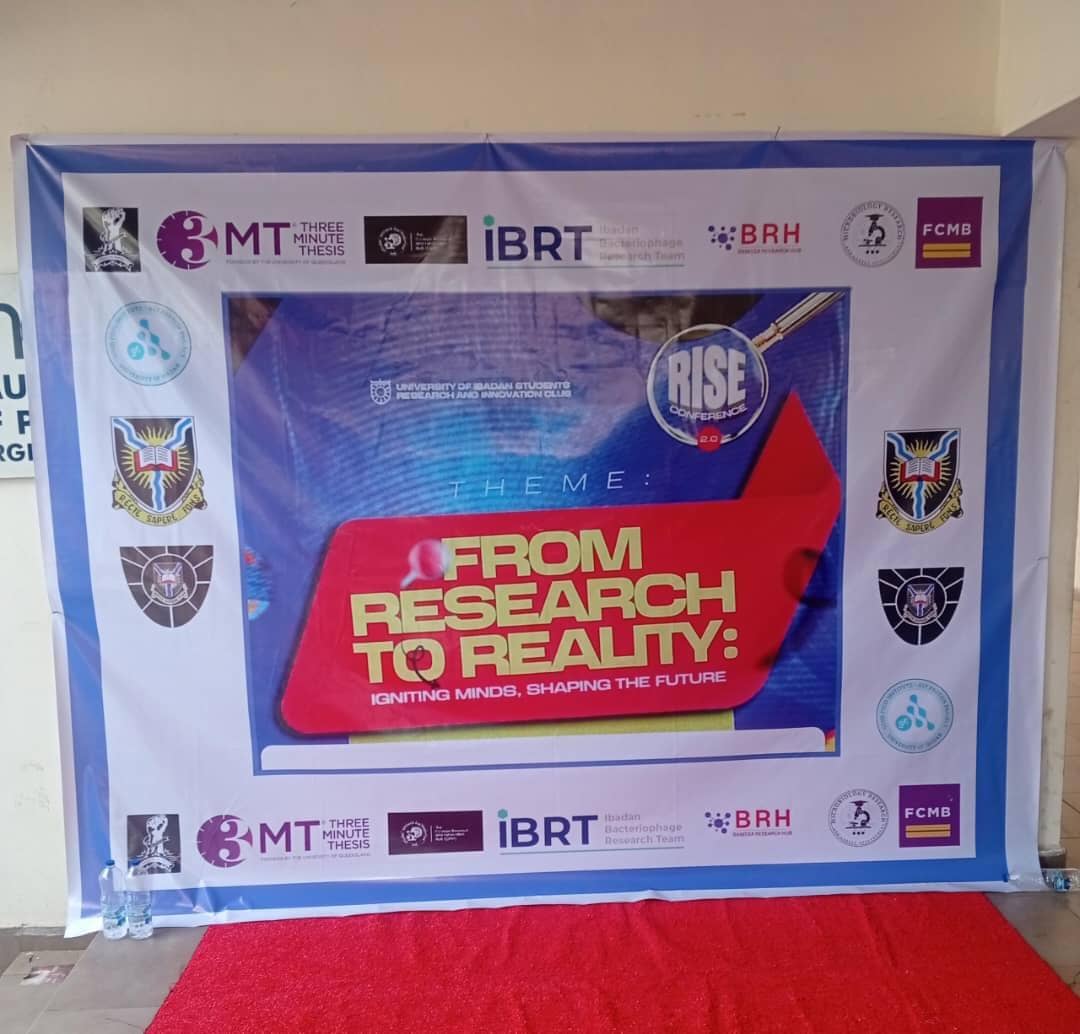
Elijah made the call at the second edition of the Research Innovation and Skills Empowerment (RISE) Conference, organised by the University of Ibadan Student Research and Innovation Club (UISRIC) at the Pharmacy Auditorium, University of Ibadan, on Saturday, 3rd October, during a keynote session titled “Funding Ideas: Navigating Grants, Fellowships and Research Commercialisation”.
He said researchers seeking funding should begin with a relevant and fundable problem, identify potential beneficiaries or a customer base, and clearly demonstrate why the research deserves financial support.
According to him, researchers should also build a funding portfolio, study eligibility requirements and proposal review criteria, and recognise when to stop pursuing funding opportunities that do not align with their research.
“Fellowships fund the researcher, not only the project”, he said, encouraging young researchers to pursue fellowships that align with their interests.
Elijah further advised researchers to identify funding priorities and tailor proposals to the interests and expectations of reviewers rather than making assumptions about what reviewers already know. “You should assume your reviewers don’t know anything”, he said.
He distinguished research undertaken for an academic degree from research as a continuing process, noting that while degree-related research is time-bound, research itself is a continuum.
He also urged early researchers to identify research priorities, ensure the reproducibility of their research, and progressively build connections and experience as they pursue larger grants.
Responding to questions from participants, Elijah emphasised the importance of environment and mentorship in the research journey, distinguishing between the roles of a project supervisor and a mentor.
“You may be lucky enough to have both in one person, but a project supervisor’s role is to help you complete your degree,” he said.
Prof. Remi Aiyede, the second keynote speaker, urged early researchers to cultivate a commitment to service and leadership, stressing that research should be directed towards realistic solutions and future applications.
Prof. Kolawole Falade, one of the panellists, encouraged students to use Industrial Training opportunities to understand industry needs rather than viewing the experience solely as a means of obtaining incentives.
He also stressed the importance of involving supervisors and mentors when developing and implementing research ideas.
Another panellist, Dr Abimbola O. Adekanmbi, discussed ways students could transform their research experiences into professional opportunities.
He encouraged students to optimise their academic and research work into engaging content while ethically harnessing artificial intelligence.
Adekanmbi also urged students to understand their strengths and potentials and deliberately develop them as a way of distinguishing themselves and beginning their professional journeys from their undergraduate years.
“Be open to learning,” he added, drawing from a scenario in which he had to supervise a topic outside his area of experience.
Dr Oluwakemi Adesola, a lecturer in the Faculty of Law, University of Ibadan, highlighted the importance of understanding legal considerations in research and innovation. “Any research without law is not good research,” she said, adding, “Innovation with law is enterprise.”
She also encouraged students to develop skills relevant to their academic disciplines, including writing and collaborative skills, while stressing the importance of interdisciplinary research.
In a pre-event interview, the Director of UISRIC, Mr Olakunlehin Adebusuyi, said the conference, themed “From Research to Reality,” was designed to highlight the importance of research and how it can translate into real-life impact.
Adebusuyi said that with young people making up a significant proportion of the country’s population, it was important to equip them with the knowledge, exposure and opportunities needed to contribute meaningfully to national development.
He identified limited mentorship and exposure to real-world research environments as some of the major gaps confronting young researchers.
In his address, Adebusuyi highlighted the activities and achievements of the club while reaffirming its mission to rekindle curiosity among University of Ibadan students and equip them with the tools to pursue research and innovation.
He also declared the Three Minute Thesis (3MT) competition open.
The competition featured undergraduate and postgraduate students presenting research and innovation projects across areas including health, finance, philosophy and artificial intelligence.
Taiwo Helen, a 500-level Nursing student, and Timothy, a 700-level Mathematics student, emerged winners in the undergraduate and postgraduate categories, respectively, while Olajide Hammed and Temitayo Isaiah emerged runners-up.
Poster presentations, networking sessions and award presentations were also featured at the RISE 2.0 conference.