by Moboluwarin Ogunleye
For the medical students living in Alexander Brown Hall (ABH), clerking patients, obtaining relevant history, and making differential diagnoses of different illnesses are a professional and personal obligation.
No one put it in a brochure. There were no prior warnings when you signed the compliance forms upon clearing your rooms, but ABH sits at a crossroads between two incredibly contrasting things. The first, a training ground of Nigeria’s future healthcare workers, and the other, a cafeteria that has, for years, been running its own experiment on how much its residents — Brownites — can absorb before something gives. The answer turned out to be quite a lot, but not unlimited. That experiment works, in part, because of what it actually means to live here.
Living in ABH can be exhausting. Very exhausting. Daily clinical rotations have no set hour they end at. You could have to be in school for ward rounds as early as 6:30am in some units to as late as 10am in other units. The daily life of your average Brownite ranges from activity-filled days to incredibly free days. Following days like the former, there’s a type of hunger that sets in after a whole day of “hustling” for signatures in the emergency department, or a whole day spent standing and answering, “Whose patient is this?”
It’s the type of hunger that sends a person straight down to the cafeteria without much optimism and the hope that whatever comes out of those vendors at said cafeteria is edible, at the very least. Fanawole or Prestige. The two main vendors in the cafeteria. Different kitchens, with different staffs and recipes, but to most Brownites in the hall, different sides of the same rusted, devaluing coin.
For many Brownites, meals from these places are the only substantial meals they will have before bed or before going for rotations. This is the context in which everything else that follows in this story must be understood.
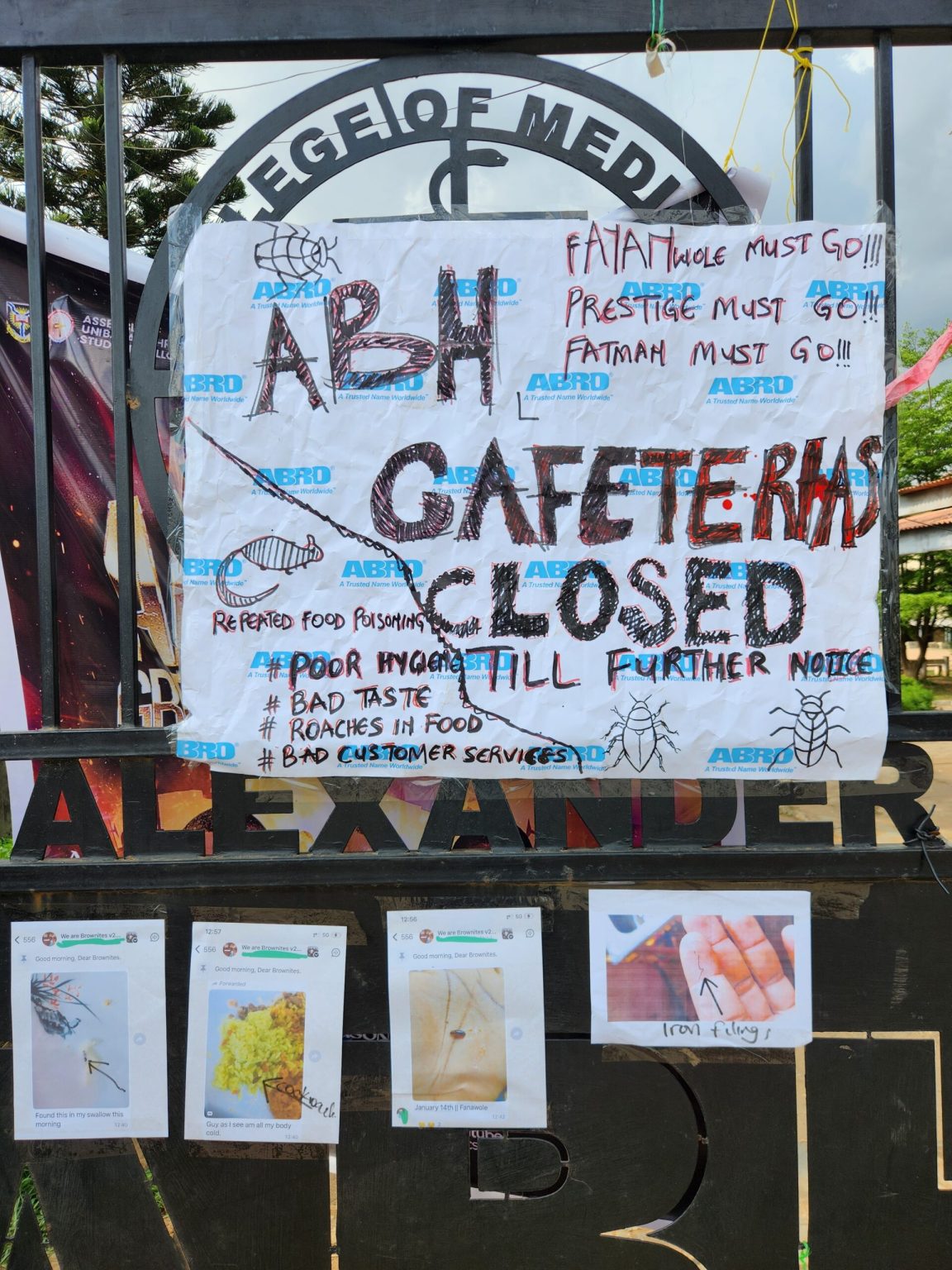
It starts as most things in this hall do, in the group chat — We are Brownites. On the 15th of March, 2026, a Brownite posted on the group that he had found iron filings in a meal purchased from Fanawole. The particles, he suspected, had migrated from iron sponges used somewhere in the kitchen.

The post landed into a group chat full of people who had been carrying similar stories for months, quietly, and within minutes, other students began sharing their own experiences, their own foreign bodies, and uneaten plates. The hall chairman was notified, and he assured residents that appropriate measures will be taken. The chat quieted and digressed to another topic. The vendors remained.
Exactly a month later, on the 15th of April, another alarm on the same chat, from another Brownite, another Fanawole meal, but this time, a cockroach. Unlike March, the chat did not simply fill with commiseration. It got filled with photos. Photos that students had been collecting over time, poorly prepared meals, contaminated food, and conditions that had no business existing in a hall within a teaching hospital.
The Social and Buttery Minister and the Health and Sanitation Minister were notified and went to query Fanawole. It did little to settle anything. The frustration had moved past the point where a query could reach it. Two days later, on the 17th of April, a third student reported a cockroach in a Fanawole meal on the same group chat. The hall chairman released a memo stating that the executive council was taking necessary action. There would be a thorough review and inspection. Any vendor found culpable would face a one-week suspension. Repeat offenders risked eviction.
The students read the memo. However, they decided they had had enough and couldn’t wait for repeat offenses. Then they made cardboard posters, walked to the cafeteria, and shut it down themselves. A notice went up at the hostel entrance signifying the closure of the cafeteria.

The timeline above spanned about thirty-three days. But that framing is somewhat misleading. The conditions that produced the 17th of April did not begin on the 15th of March. They had been building quietly for considerably longer than that. What happened in March did not give the students a new problem; it simply brought to the surface something they had been living with for way longer.
Temiloluwa Oyaromade, a member of the 2k26 MBBS class, has two memories from the vendors that have stayed with him. The first: he had gone for bread and beans and was considering adding fish to his food when he looked at the glass container. “Multiple flies roaming within the glass container of fish.” He changed his mind and took the bread. Which was no better, as he found fungi growing on parts of it.
The second time, he bit into his beans and hit a stone. “With how big the stone I bit on was,” he says, “I am actually lucky to have gotten away with no broken teeth. ” He has not bought food from any ABH stall since. “Given the number of complaints that have cropped up on this matter,” he adds, “it was a very wise decision on my part.” He says this without drama. It is simply a conclusion he arrived at and acted on.
Temiloluwa was not alone in that decision, as many other students made the same calculations and stopped going. They simply just absorbed the inconvenience and said nothing. But this individual exit from the cafeteria is not a solution. It’s simply defeat — accepting defeat.
Unique, a member of the 2k24 MBBS, arrived at the same defeating conclusion: “The food from all the restaurants tastes horrible. Absolutely horrible, and I almost always get food poisoning, so I had to stop buying.” Past tense, decision made, moving on. Abdulwasiu Muhammad, a 500-level MBBS student, also had food poisoning “a couple of times.” But besides the quality of the food, he also noted that “the ladies at Prestige are very rude” and that Spicy Bites, a vendor in the middle of the cafeteria, popularly known as “Fatman” by long-term residents of the hall, “has very expensive stuff, and he doesn’t care.”
Like Unique, Abdulwasiu has moved on too. These are not extraordinary testimonies. That’s precisely the point. They are very ordinary.
Moving on, Segun Sonibare, a 400l MBBS student, bought egusi with fufu from Fanawole sometime in January and, in retrospection, described it to the press as “the most retch-inducing, noisome, revolting soup I’ve had the displeasure of tasting in years.” His descriptions feel exhausting, but not as much as Durojaiye Olanrewaju, 2k24 Dentistry student, who keeps a more exhaustive accounting.
“Every time I bought food from either of the cafeteria vendors, there was always a foreign body,” she says. “Either cockroach, housefly, iron sponge, or even broom.” Three separate incidents of food poisoning since moving into ABH with one hospital admission. She is training to join the healthcare workforce of a country that badly needs her. Ironically, she was admitted to the hospital outside her bedroom window because of what she ate for dinner. This is not a metaphor. It actually happened.
Narrating a similar experience, Oyetunji Abdulbasit Oyebamiji, also in the same 2k24 class, was rushed to the staff clinic earlier this year; “I almost died earlier this year as I was rushed to the staff clinic and was diagnosed with food poisoning after episodes of vomiting and excruciating stomach pain.” He traced the meal back to Fanawole. “Na me know wetin my eyes see,” he says. “I couldn’t even finish that food. I had to tell them to keep the change and left. Still, I landed in the hospital. It’s crazy.”
He had paid, eaten what he could stomach, surrendered the change, and walked away. The illness followed him any way. And then, there is the customer service, which is a different story altogether. Itodo Alexander, in the 2k26 MBBS class, goes to the counter, pays his bill, and consistently, reliably receives an angry response. While the quality of the food he would be getting might be questionable; the constant is that the customer service would be abysmal. “To put it bluntly,” he says, “describing what follows as laziness is nothing short of a disgrace to laziness itself. Laziness would plead innocence.” He is not describing a difficult day dealing with these vendors; he’s talking about the standard he — a new resident— is being asked to grow accustomed to, ascribing no difference to the vendors. Prestige or Fanawole: two sides of the same coin.
The food is poor and the people serving it are hostile about it. Both things, apparently, are part of the offer.
The emergency town hall was held the following evening. It was, in the best sense, the worst of meetings and the most necessary of meetings. The volleyball court was full of people complaining about different things, realizing they had not been alone: Jay, the bread and egg vendor beside Mama Kay, allegedly wiping sweat from his hands mid-service before returning to the food. Rat infestation. Dirty kitchens. Portions that mysteriously shrank for Brownites. In as much as we could slam democratic intentions on the hall chairman’s request for Brownites to ‘vote in or out’ for every vendor, it’s a subtle disregard for the cries of Brownites all day and a more crooked attempt to save the faces of these vendors.
Some of the resolutions reached at the town hall include gloves, hair caps, name tags, a three-strike rudeness rule, equal portions, warm food, and standardized hours for whichever vendors eventually come to stay.
Besides these resolutions, however, speaking to the press, Oguntoba Folagbade from the 2k25 MBBS class had a proposal: “Every three months, a poll should decide which vendor gets cancelled. Fanawole, yes or no, on a Google doc; all of us should vote.” It is, on reflection, the most democratic solution anyone put forward. A system that keeps vendors permanently accountable to the people eating their food, not just during crises.
Itodo Alexander’s position was less patient: “It’s time to send away Fanawole and Prestige, and if they can’t be sent out, an extremely severe punishment must be imposed so that whenever they think they should be negligent, they will remember what price they had to pay the last time.” Abdulbasit, who had allegedly been in a hospital bed because of a Fanawole meal, was straightforward: “It’s high time they close that place down and get a better vendor. It’s getting alarming, honestly.”
Different students, similar conclusions.
Whether the evictions hold or not, whether the replacements are better, or whether the resolutions survive till the next session, these are questions we’ve had to answer before in different forms and have not always answered well. As always, the demonstration was, in certain ways, the best of intentions and the most uncertain of outcomes.
But what it showed is that the patience of Brownites is a resource that can be exhausted. As of writing this article, the cafeteria remains closed.