
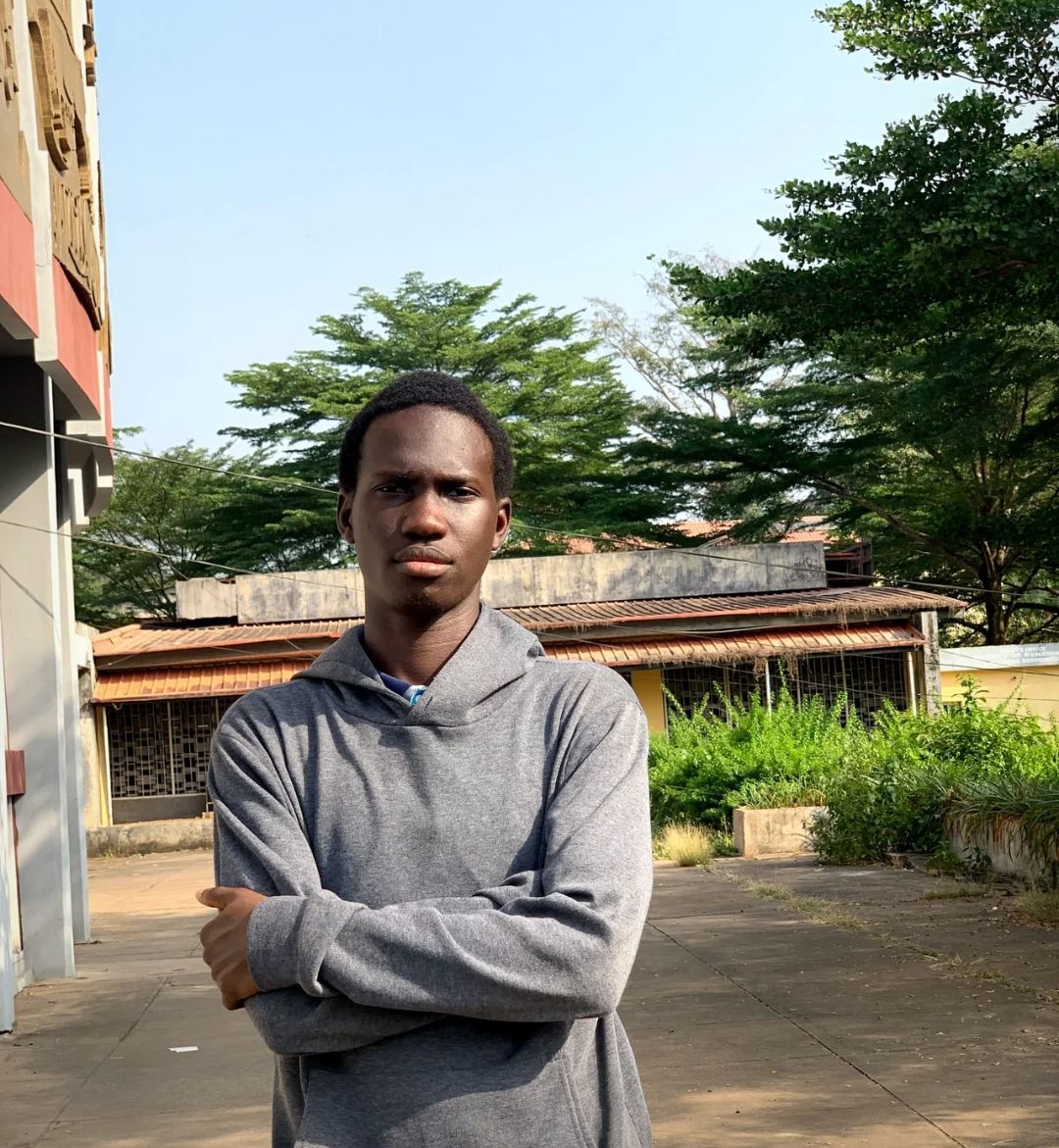
By UCJ Election Watchroom
Abiola Olaniyi Isaac is one of two candidates running for President of the University of Ibadan Students’ Union. At the Students’ Union Electoral Commission (SUEC) physical screening on 24 October 2026, he scored 82.17—the second-highest mark among the 14 candidates cleared for all offices.
A student of Agricultural Extension and Rural Development, he currently serves as Chairman of the Students’ Representative Council (SRC) Finance Committee in the 13th Assembly.
His campaign banner, “The Paradigm Shift,” is built on a single shift: moving from accepting what is normal to examining what should be normal.
It rests on three pillars: leadership that delivers, a stronger and more accountable Union, and a campus built around academic and professional excellence, guided by the motto “service before status.”
However, his campaign currently lacks specified budget lines, deadlines, or measurable targets, leaving voters unable to determine what will be delivered, by when, or at what cost.
In a 24-video interview with Dee Psalmist, Mr Olaniyi explains that the concept stems from an agricultural communication course, transitioning from a top-down model to a bottom-up, emergent one.
This approach aligns with a Union whose founding purpose includes serving as a channel for student involvement in university management.
Yet, no congresses, consultation processes, or published agendas have been formally outlined.
While his proposals for student communities, support for innovation clubs, and spotlighting student excellence sit within the Union’s powers and would be inexpensive, they lack names, dates, costs, or responsible owners.
Furthermore, his claim that the university has more than 200 underused exchange programmes remains unconfirmed—and because exchange programmes fall under management authority, it remains to be seen whether a Union president can alter them.
Verifying the Record and Committee Experience
Mr Olaniyi’s campaign materials and official site list a broad range of leadership roles.
These include co-founding the Hope2School education outreach, serving as Secretary and later Chairman of his Faculty Academic Committee, acting as Administrator General of Independence Hall, and chairing a hall food bank.
His campaign flyers also clarify his welfare and institutional background by documenting his service on several key union bodies:
- Serving as Secretary of the UI’SU Price Regulatory and Implementation Committee.
- Serving on the UI’SU Health Advisory Committee and the UI’SU Helpdesk Committee.
- Chaining a food bank to address student hunger directly.
- Participating in legislative oversight as a member of the Faculty Legislative Council, Chief Whip, Audit Committee chair, and an SRC member.
Despite these additions, some figures require independent cross-checking. For instance, the claim that his Learning Hub grew participation from about 50 to over 300 students still relies on unverified internal metrics.
Furthermore, minor inconsistencies remain between his interview summary and campaign documentation—such as descriptions of his role as an academic committee chairman versus secretary, or whether he “helped develop” versus “set up” the Learning Hub. A candidate asking to be entrusted with union records should reconcile these details.
Financial Scrutiny and Freshers’ Week
The Finance Committee’s official role is to scrutinise and approve budgets rather than disburse funds, spending is managed by treasurers and executives, while audits and project monitoring committees review execution afterward.
Therefore, Mr Olaniyi should be judged on whether the budgets his committee signed off on were properly examined.
During Freshers’ Week 2026, the evidence supports his oversight record. The Executive proposed a headline figure of roughly ₦14.43 million (₦12,487,462 plus ₦1,942,100 for pageantry), but the committee trimmed it down to an approved ceiling of ₦5,719,770—a figure explicitly featured in his campaign literature.
Mr Olaniyi noted that the final document reached the committee late at night on 1 April, prompting three separate sittings to cut the excess.
Three complications accompany this process:
- Approval Timing: The committee approved the budget before the full House had heard it. Although questioned by some members, the Speaker defended the action under constitutional powers.
- Audit Findings: An audit on 8 May 2026 found actual spending of about ₦5.1 million—below the approved ceiling, supporting the view that the trimmed budget was workable. However, the audit also flagged undocumented spending and discrepancies, referring the Assistant General Secretary to the Disciplinary Committee.
The Union Week Question and Recent Context
Union Week 2026 ran in mid-September, featuring lecture-free days, Ojude UI at the Old Stadium, and the Vice-Chancellor’s Marathon (UIMSA Press).
An unverified figure of ₦36 million was reportedly spent on the event, with no public statement of SRC approval, published budget, or audit found at the time of writing.
The Constitution explicitly requires Council approval before executing Union Week. Precedent shows the SRC takes this seriously: in 2025, the Council referred a Vice-President to its Disciplinary Committee for running the week without approval.
Because late approvals appear to be a recurring habit within the assembly, Mr Olaniyi must answer a direct question: Did his Finance Committee see and approve the Union Week budget, and when?
What He Must Further Answer
The Union’s founding purpose is to foster student interests, provide a forum, and serve as a channel for student involvement in university management.
Bottom-up consultation and career programmes fit comfortably within this framework, though critics argue the Union has drifted from an active pressure group toward passive dialogue.
Before polling day, It would help Mr Olaniyi to clarify:
- When his committee received and approved the 2026 Union Week budget.
- What became of the Freshers’ Week audit referral.
- The specific outcomes of his work on the UI’SU Price Regulatory, Health Advisory, and Help Desk committees.
- Where his Learning Hub participation figures originate.
- How he voted on the ₦50 million Odidiomo pledge, which the UCJ notes contravenes the constitution.
All these and other questions on his position towards active unionism as a student pressure group are also worth clarifying, as it would look to what really is the strength of his mandate in wanting to be the next UI’SU president.