By Debbiemuse
A teacher leaves the classroom every day, but a little of the teacher remains behind.
It may be written in blue ink across a page, underlined in red beneath a sentence that could have been better. It may be tucked between the pages of a notebook, hidden inside a corrected examination script or carried in the memory of a student who cannot remember the topic of the lesson but remembers exactly how the teacher made them feel. The bell rings, the students leave, the board is cleaned; the lesson, however, does not always end there.
Teaching is often measured in familiar quantities: the number of students in a classroom, the number of lessons taught, the grades recorded, the examinations passed. Yet some of the most important things a teacher gives cannot be entered into a register or reduced to a score out of 100.
A teacher leaves things behind.
Sometimes, it is a word.
“You can do better.”
“You are capable.”
“Try again.”
“Don’t be afraid to speak.”
Words are among the smallest things a teacher gives, but they can become surprisingly heavy with time. A sentence casually spoken in a classroom may become a student’s private vocabulary for surviving difficult seasons. Years later, when confidence is running low, and failure seems louder than possibility, that old teacher’s voice may return, not from the classroom, but from memory.
That is one of the amusing things about teaching: a teacher may forget saying something that a student spends years remembering.
Then there are the corrections.
Nobody particularly enjoys being corrected. Something is humbling about seeing a page covered in markings, arrows and comments, especially when the red ink seems to have developed a personal vendetta against one’s grammar. Yet correction is one of the quietest forms of care.
A teacher who says, “This can be better,” is refusing to let a student settle for less than they can become.
The correction of a misplaced comma may seem insignificant. The insistence on a clearer argument may appear tedious. The repeated reminder to show up, pay attention, read widely or do the work properly may sound like another lecture. But somewhere between the first correction and the hundredth, students begin to understand something beyond the lesson itself: excellence is often built through revision.
Even teachers leave room for second drafts, and perhaps students are not the only ones being taught. Every classroom teaches a teacher something. A lesson that worked perfectly yesterday may fall flat today. A question from a student may expose a gap the teacher did not know existed. A particularly difficult class may test patience in ways no textbook could have predicted. Teaching requires knowledge, but it also demands humility — the willingness to learn while standing in front of people who have been told they are the ones who came to learn.
There is another thing teachers leave behind: questions.
The best teachers do not merely fill empty pages with answers. They disturb comfortable assumptions. They ask why and how. They ask, “What do you think?”
A good question can follow a student far beyond the classroom.
Why do we believe this?
Could there be another way?
What if I tried?
What if I am wrong?
What if I am right?
Education becomes meaningful when students stop learning only what to think and begin learning how to think. In that sense, a teacher’s greatest achievement may not be producing a student who remembers every fact from a textbook, but one who has developed the curiosity to keep asking questions after the textbook has been closed.
And then there are the students teachers do not forget.
The brilliant ones, perhaps, are easy to remember. So are the mischievous ones whose names somehow become permanently attached to stories told in staff rooms years later. But there are also the quiet students, the ones who sit at the back, rarely raise their hands and leave little evidence that they are listening.
There are students who understand quickly and students who need someone to explain the same thing in three different ways. There are students who arrive with confidence and those who arrive carrying problems no teacher can see.
For some of them, a teacher becomes more than the person who teaches a subject.
A teacher notices. A teacher asks, “Are you alright?” A teacher gives another opportunity. A teacher refuses to write a student off because of one poor examination, one bad decision or one difficult season. Sometimes, the most important lesson is simply being seen.
This is why the work of a teacher can be difficult to measure. A teacher may know the grades their students earned, but may never know the full extent of what they helped create. The student who eventually becomes a doctor, lawyer, journalist, engineer, artist or teacher may carry traces of dozens of educators whose names rarely appear in the final story.
And, occasionally, some of those students becomes a teacher too. Then the circle closes.
A former student stands before a new classroom, holding a marker, a lesson plan and perhaps an unconscious collection of mannerisms borrowed from teachers who came before. The phrases change slightly. The examples become different. The faces are new, but somewhere in that new teacher are pieces of old classrooms. A teacher leaves behind another teacher. That is one of education’s most beautiful forms of continuity.
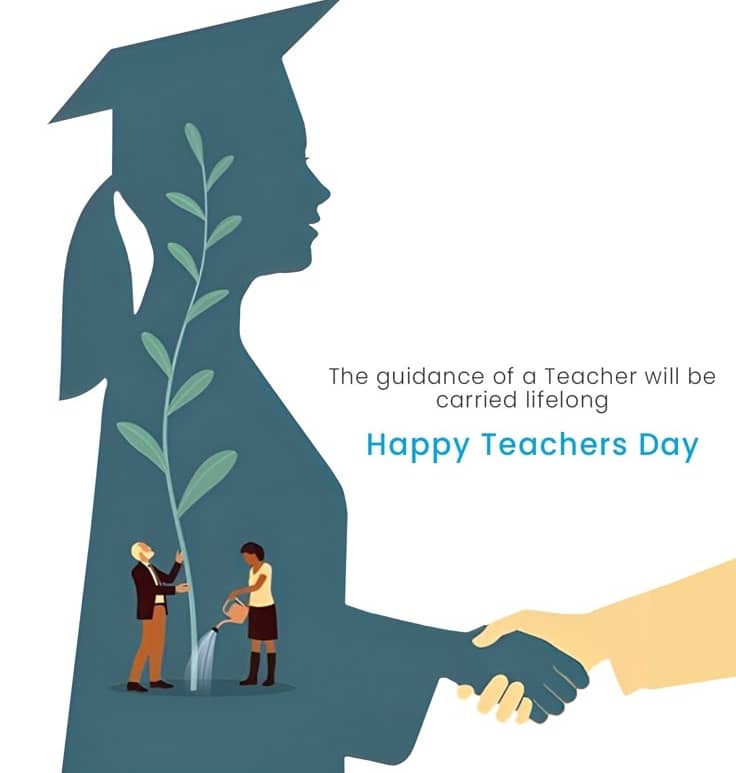
So, on Teacher’s Day, it should not only be, “What has a teacher taught?”, but also, “What has a teacher left behind?”
A lesson? Certainly.
A correction? Probably.
A question? Hopefully.
A little courage? Perhaps.
A memory? Almost certainly.
Because classrooms disappear. Timetables change. School uniforms are outgrown. Examination scripts are eventually discarded. The chalkboard is wiped clean at the end of every lesson, but not everything can be erased.
Some lessons settle into the way a person speaks. Some corrections become discipline. Some questions become curiosity. Some encouragement becomes confidence. Some teachers become stories, and some stories become lives.
A teacher may leave the classroom every day, but the classroom does not always leave the student. That is the thing a teacher leaves behind.