By Emmanuel Omolayo
Two banners on this campus claim to target the same issue, INDECENCY, but look closer, and they are contradicting each other in a very wide respect.
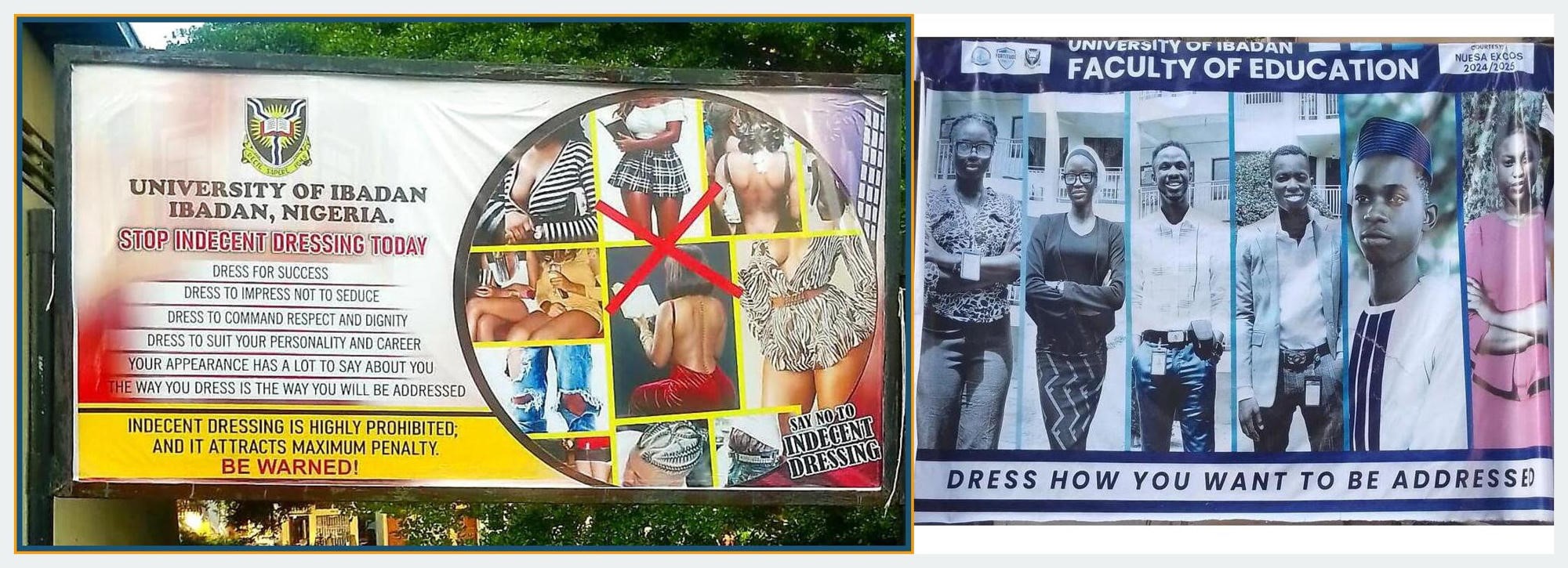
The first is stationed at different locations across the campus, along Access Bank Road, at Kenneth Dike Library, another adjacent to the road toward Zik Road, within sight of Bello, and another welcomes you at the entrance of UI. This banner bears the crest of the University of Ibadan, a bolded statement: “STOP INDECENT DRESSING TODAY” and a list of good moral virtues: dress for success, dress to impress, not to seduce, dress to command respect and dignity, dress to suit your personality and career, your appearance has a lot to say about you, and the way you dress is the way you will be addressed.
Beside the sermon is a grid of eleven photographs, eight cropped tight on a body, with red X slashed through them. Bare backs. Short skirts. Ripped jeans. The images contain body parts structured into a warning. As if the images are not adequately doing the persuasion, at the bottom is a warning to the UI community: “Indecent dressing is highly prohibited, and it attracts a maximum penalty. Be warned!”
The second banner, located at the Faculty of Education, courtesy of the 2024/2025 NUESA executives, carries the same university crest, with a similar message, “Dress how you want to be addressed,” but with a whole lot of difference in addressing the public. Six students stand in individual portraits, dressed smartly in a way that suggests the kind of appearance expected of a student who has made an effort: a leopard-print blouse and trousers, a blazer over a shirt, a simple pink dress. An implicit invitation: here is what looking good here actually looks like.
Same school. Same focus, almost word for word. Two opposing theories on how to change behaviour.
The first is built on shame. Exposing body parts excessively and then threatening consequences. It is worth asking, plainly, did the people who arranged those images see the contradiction portrayed in their own design? The images selected to symbolise “indecent dressing” are, by far, more exposed than what the average UI student wears to a lecture on an ordinary Tuesday morning. The banner had to stretch for extremes to produce the very problem it claims to address.
It is not coincidental that messages built on shame often have to exaggerate the offences to equal the height of the punishment attached.
The images are not depicting the reality of the student populace. As a result, the message can easily become a caricature of its audience rather than a true model of them. This makes it very easy to ignore, hate, or quietly mock rather than to actually absorb.
The second banner at the Faculty of Education does a different job psychologically. The design shows students who are modestly dressed and well positioned for the view of everyone passing by. In behavioural terms, this is modelling: portraying the desired behaviour through a clear and real example rather than placing threats and punishment in its absence. Positive modelling delivers the message to the viewers by demonstrating what is expected and often draws attention and conformity, but a shame-based approach, on the other hand, can provoke resistance or dissonance, particularly among young adults who are just exploring their independence.
In simpler terms, one banner appeals to the audience’s aspirations, while the other instils fear and accompanies that fear with irritation.
Ironically, these banners do not just disagree; they are against each other while insisting they are sending out the same message, on the same campus, bearing the same crest. The first banner appears to undermine the very standard it tries to police. The Faculty of Education sign, meanwhile, communicates the standard without threatening the viewers into it.
If the university administration indeed prioritises students’ dressing, there is already a better example on campus: the banner at the Faculty of Education, which models the dignity and pride it seeks to promote, instead of the school gate, the SUB court and halls of residence, where a red X is doing all the talking to every passer-by.
After all, if the goal is to change behaviour, perhaps the better question is not only what should students be warned against, but what should they be encouraged to become?