

Books and all forms of writing are a threat to those who wish to suppress the truth.
—Wole Soyinka
In every democratic society, the press is often described as the watchdog of the people, the voice that questions, informs, and preserves accountability.
Within the university environment, this role becomes even more delicate and essential. Campus journalism is not merely about publishing articles or covering events; it is about documenting the realities of student life, amplifying student voices, and ensuring transparency within the university community.
Press freedom, therefore, refers to the ability of journalists and press organisations to gather, produce, and disseminate information without intimidation, censorship, suppression, or undue interference. In the context of campus journalism, it means allowing Local Press Organisations (LPOs) the independence and support needed to operate effectively in serving the student body. Sadly, this freedom often exists more in theory than in practice.
This growing hostility towards independent journalism is reflected in actions such as the April 17 notice issued by the National Broadcasting Commission (NBC) to broadcasters regarding the reviewed broadcast code. Certain provisions of the NBC Code, particularly Section 1.10.3, stand in contrast to internationally accepted standards of press freedom and further raise concerns about the shrinking space for journalistic independence in Nigeria. By sanctioning journalists or presenters for clearly identified opinions, such provisions threaten one of the core missions of journalism, which lies in freedom of expression, analysis, interpretation, and independence from external influence and government interference. Actions like this not only weaken journalistic confidence but also encourage a more rigid and fearful form of journalism where scrutiny becomes restrained and critical engagement slowly disappears.
According to the CJID press attack reports, about 1,879 attacks have been recorded across five West African countries, with 1,328 of those attacks recorded in Nigeria. The attacks include physical assault, unlawful arrest and imprisonment, sanctions, access denial, harassment, and threats.
These figures not only show attacks on journalists but are a deeper reflection of the level of injustice and weaponised fear across different quarters, where security agencies, who are meant to protect citizens, now cut in the same direction as public figures acting above the law. The painful reality is that crimes against journalists often go unpunished even when perpetrators are known or apprehended, and there is almost no stated mechanism for protection.
Institutional Hostility Toward Campus Journalism
Similarly to the tactics used in the mainstream, we also see this take shape within the student community when wielders of power, that is, student leaders elected to govern the affairs of fellow students, refute interrogative questions and resist accountability. History has shown that those in power often attempt to discredit the work of the press. In the 2023/2024 academic session, we can recall the Vice President of the union denying a statement she made in what appeared to be an intentional act to undermine the position of the press as an unbiased institution, and this was later found to be misleading and deliberate.
This is not the first instance. A more recent occurrence was the congress held on September 20, 2025, by the Auspicious team, which reflected how the union president, rather than directly answer the question posed to him in regards to the financial allegations levelled at the Union’s executives, used the platform to discredit campus journalism. An action he never returned to correct despite the fact that the established claims aligned with the findings of the University of Ibadan Students’ Representative Council.
Campus journalists have been made to face certain levels of threats and intimidation while trying to fulfil their duties and uphold the rights the press holds within the student community. Some alterations to published articles were demanded by student leaders or hall management over what they described as “defaming” content from the press.
Criminalisation of Dissent
The greatest threat to freedom is the absence of criticism – Wole Soyinka
Across the halls of residence, several episodes of this injury to the purpose and existence of the press remain evident. One such instance occurred during the last session at Zik Hall of Residence, when hall politics were turned upside down, and student leaders who were to govern students for the next ten months were not subjected to proper scrutiny, where their plans and agendas would be examined.
Halls of residence like Awo Hall are not far from such realities, from denial of funds to cases of press intimidation where the independence of the press was threatened. Faculties like the Faculty of Arts also witnessed instances where student leaders mandated that certain stories be pulled down despite the existence of undeniable facts. At the beginning of the semester, a similar friction occurred within the Faculty of Education, where the press was expected to seek approval from the Public Relations Officer before certain stories could be released.
As reported by NUESA Press, barely weeks after assuming office, the current administration repeatedly expressed dissatisfaction with the activities of the press. Deliberate attempts by executive members to dictate what the press should report and what it should not report were also recorded. This once again reflects the inability of many within positions of authority to distinguish journalism from public relations. As George Orwell once noted, journalism is printing what someone else does not want printed; everything else is public relations.
As seen with the harassment faced by mainstream journalists from security personnel, where officers have manhandled journalists while carrying out their duties, that same reality can also be related to the experiences of campus journalists at various instances.
On March 7th 2025, during an attempt to record the forceful removal of Nice Linus, a disqualified yet elected SRC member, from the inauguration ceremony marking the transition from the Aweda-led administration to the Odedele-led administration, members of the university security unit manhandled and detained Akanni Oluwasegun, then a UCJ’UI News Editor and additionally UCJ’UI President Ogunrinu Olanshile was physically assaulted. Although the attack sparked criticism and condemnation from concerned human rights bodies, the incident was not far-fetched within the wider reality of press intimidation.
The Contradiction Facing Some LPOs
Like an unseen force, institutional fear also contributes to this reality, with cases like that of Kunle Adebanjo, who was rusticated for two semesters over an article he wrote on the deteriorating state of Kenneth Mellanby Hall titled “UI: The Irony of Fashionable Rooftops and Awful Interiors.” The then university management justified its action by categorising the article as defamatory.
Campus journalism has, over time, continued to suffer from the lashes imposed by these actors within the system. These incidents have remained reference points used to intimidate students while discouraging them from pursuing welfare-related and accountability stories. And that is the contradiction many campus press organisations, including Awo Press, continue to face.
A press body cannot function effectively when the very structures needed for its survival are gradually stripped away. One major challenge has been the recurring issue of budget allocation. Funding remains one of the strongest determinants of how efficiently a press organisation can operate within a session. Whether it is covering important events, publishing timely reports, or maintaining a consistent media presence within the hall, financial support remains essential to the survival of the press.
It was therefore deeply concerning when the allocation to Awo Press was reduced from ₦19,500 in the previous session to ₦15,000 in the current session. While this figure may appear insignificant to some, the implication on the functioning of the press is far-reaching.
A press organisation already battling rising operational costs cannot be expected to thrive under shrinking support. The question then becomes, how exactly is the press expected to carry out its responsibilities efficiently when the tools required for its operation are continuously weakened?
Even more troubling was the incident involving the room officially dedicated to Awo Press within the hostel. Due to accommodation shortages, the room was reassigned for residential use by the hall administration. Although the decision may have been influenced by accommodation challenges within the hostel, it nonetheless drew attention to the difficulties campus press organisations often face in carrying out their activities effectively.
The consequences were immediate as important documents, manifestos, and press materials had to be hurriedly moved out, leaving members without a stable operational space. For a body whose responsibility revolves around documentation and information management, losing its designated office is not merely inconvenient; it is symbolic of how little value is sometimes attached to campus journalism.
This is a problem that extends beyond the immediately cited example. Beyond this one LPO cited and elaborated on, several others of our LPOs have had to face up to issues of threats of withheld funding, expulsion from their spaces and even legislative overreaches where members of parliament in various constituencies threaten EiCs with a move to remove them from office, even though this is not within the scope of their power to do. This is done on the backdrop of the press publishing factual stories which unsettle them for various reasons.
This also extends beyond just the students to calls from “high places” being directed to the parents/guardians of certain of our editors in chief, and even threats of lawsuits, all in a bid to hound our brave and credible reporters and deter them from factual stories.
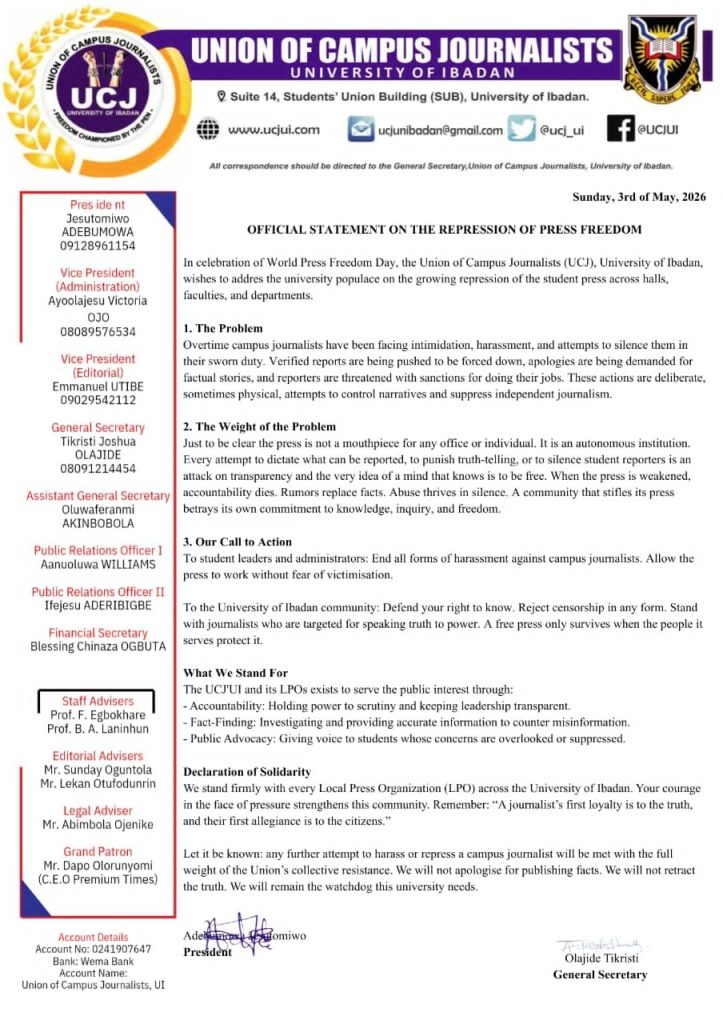
All this informed the UCJ release during the press Freedom Day, condemning the disturbing trends that were observed, reiterating UCJ’s commitment to stand strongly and fully behind the interests of all its members and also UCJ’s readiness to mobilise all its resources to ensure that all such acts are not just allowed to fly.
The Burden of Press Freedom
A weakened press ultimately creates a weakened student community because accountability suffers in the absence of a strong and independent media presence.
—UCJ
The goal of the press is not chaos; it is balance. It is not hostility; it is responsibility. The press exists to inform, to question where necessary, and to preserve the integrity of the university system through truthful reporting.
The freedom of the press is not only a right to protect but also a responsibility journalists carry in a climate where truth constantly faces pressure. Campus journalists do more than write stories or break news; they navigate systems that question, resist, and sometimes deliberately undermine their work.
Unfortunately, People often misunderstand campus journalists. Some view press organizations as antagonistic bodies whose sole purpose is to criticize leadership or publish negative stories. But this perception misses the essence of journalism entirely.
A weakened press ultimately creates a weakened student community because accountability suffers in the absence of a strong and independent media presence.
The goal of the press is not chaos; it is balance. It is not hostility; it is responsibility. The press exists to inform, to question where necessary, and to preserve the integrity of the university system through truthful reporting.
Despite institutional pressures, the role of the press remains unchanged. It is to question, to document, and to hold power accountable, even when that power exists within student community settings. If campus journalism is to remain relevant and respected, institutions must cease to treat scrutiny as hostility and must recognise the press as a necessary instrument of accountability rather than opposition. The purpose of the press is not noise, it is clarity.
The press is not the enemy of the system. The press is one of the systems keeping the university community alive, informed, and accountable.
In the end, the freedom of the press is not a gentle dejected request; it is a right that must never be trampled upon.