
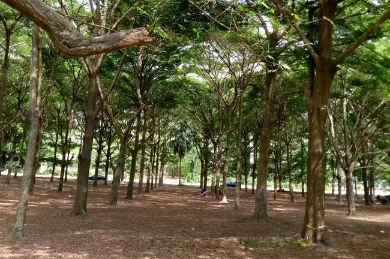
Heritage park before the tree felling
One of the most prominent events that occurred last week was the 29th annual summit of the Conference of the Parties (COP) under the United Nations Framework Convention on Climate Change (UNFCCC). The summit provides an avenue for various world leaders to meet and collaborate in innovating and creating effective solutions to the problem of climate change. However, similar to a perfect deployment of oxymoron, on the penultimate day of the summit, another prominent occurrence happened, but it was one peculiar to the University of Ibadan. The university cut down the trees of Heritage Park, which is one of the most notable green areas present on the university campus.
The peculiarity of Heritage Park transcends the fact that it is a green area at the university. Its geographical positioning and time-developed cultural significance make it an even more important aspect of the university’s identity. However, this is not an identity peculiar only to the university as an institution but one also specific to students, alumni, staff members, and other concerned stakeholders of the University of Ibadan.
The justifications for the deforestation act, while not officially disseminated by the university management, have been broadcast by certain “trusted information sources” of the university. The Student Union President, Aweda Bolaji, has relayed the necessity of cutting down the trees as a demand of infrastructural development and one being compensated by the planting of trees at other geographical areas in the university.
Nevertheless, while an attempt at compensation indicates some sort of remorse for the tree cutting, the execution of the deforestation action still has unmitigated consequences. Deforestation in a particular area and afforestation in another area do not totally compensate for the initial deforestation exercise—at least in the area where the trees were cut down. This is a fact that plays out in various ways.
Walking from or to the school gate in the afternoon, which is often characterised by being bathed in the scorching sun, is obviously very discomforting. One of the places of succour from such unpleasantness used to be Heritage Park, which now no longer exists. The presence of another park on campus does not in this context mediate for the absence of greenery where it used to be.
The biological or natural carbon sequestration process in the area where Heritage Park used to be can never be the same again. Carbon sequestration refers to the long-term process of carbon dioxide being captured and stored in plants. With the absence of the trees, it is inevitable that the amount of carbon dioxide in that particular area will be on the rise and will not be at the level it was before, despite the afforestation action executed.
Beyond the environmental impacts of this action, it has a cultural consequence. Heritage Park, like most other landmark areas and buildings at the University of Ibadan, is one that is culturally significant to the university community both past and present. In a historic institution like the University of Ibadan, such an area is one that will jointly hold memories with a large number of individuals who have attended the university. From the boisterous convocation parties to the more tranquil gatherings of students, the park has witnessed it all. It has now seized to be a witness, and with it has vanished a part of the University of Ibadan’s culture. Ceteris paribus, by 2030, all undergraduate students of the University of Ibadan would have no posteriori of Heritage Park. Another group of trees at another point on campus cannot replace the cultural significance of Heritage Park to the university community.
However, the justification for the deforestation act is one that cannot be inherently faulted. The process of infrastructural development in one manner or another is one that will positively influence urbanisation, which consequently has its own positive benefits. Years before the proliferation of information about climate change and the importance of greenery in sustaining the ecosystem, such an act would mostly be seen in the light of development, devoid of the negative consequence on environmental well-being. At the same time, knowing about the disadvantage of such actions now makes it imperative to ensure that there is an intersection of environmental sustainability and infrastructural development.
The decimation of the Heritage Park is obviously one that does not sit well with the majority of the university’s stakeholders, and whether by oversight or the assumption that people would not take it too seriously, the university could have done better in communicating its decisions and carrying its publics along about bringing down the park before it was actually done. This should have been done to make everyone understand and accept the compromise of such an action.
While the university management has said to carry out afforestation to compensate for the loss of Heritage Park, it should do well to retain some of the heritage of the now decimated park. This it can do by ensuring that there is some sort of similarity between the now nonexistent Heritage Park and the structure that is being planned to take its place. This could be in line with the function (environmental or shade) or aesthetic properties that the park provided the student populace.
Like the expression popularised by the Spider-Man franchise, “with great power comes great responsibility,” the university needs to greatly make up for its decision to bring down the park. Whatever infrastructure is to be constructed will not be a normal one but one whose foundations will be resting on history. The infrastructural project to be carried out gives the opportunity to the university management to carry out a major environmentally friendly project. This it can do by employing sustainable building materials, integrating renewable energy, and incorporating sustainable designs, among others. Deploying these lines of action in conjunction with the afforestation exercise will not only to a justifiable extent compensate for the removal of the park but also improve the image and reputation of the University of Ibadan. If properly executed, the university can set the pace and be one of the trailblazers of sustainable development in the institutional sector of Nigeria and Africa.
Notwithstanding, this occurrence should initiate a recalibration of the concept of development in the university community and the society at large. Is development really development if it has to take a bit of our culture, history, and well-being with it? While the first response to a growing need is to create and produce more, sometimes the more appropriate solution is to use less