
by UCJ Election Watchroom
The Role of the Disciplinary Committee
The Disciplinary Committee of the Students’ Representative Council (SRC), University of Ibadan, plays a vital role within the structure of the Students’ Union (SU).
It exists to hear and determine cases involving members of both the executive and legislative arms who have been accused of erring, which can range from financial irregularities to constitutional violations or disregard of SRC directives, this is as provided in Article XXVII, Sub-article V, paragraph (d) of the Students’ Union Constitution.
Essentially, the committee functions as the judicial arm of the SRC as it is responsible for upholding accountability, discipline, and fairness. Its credibility depends on impartiality and freedom from political influence.
However, recent events have raised serious questions about that impartiality.
A Question of Impartiality
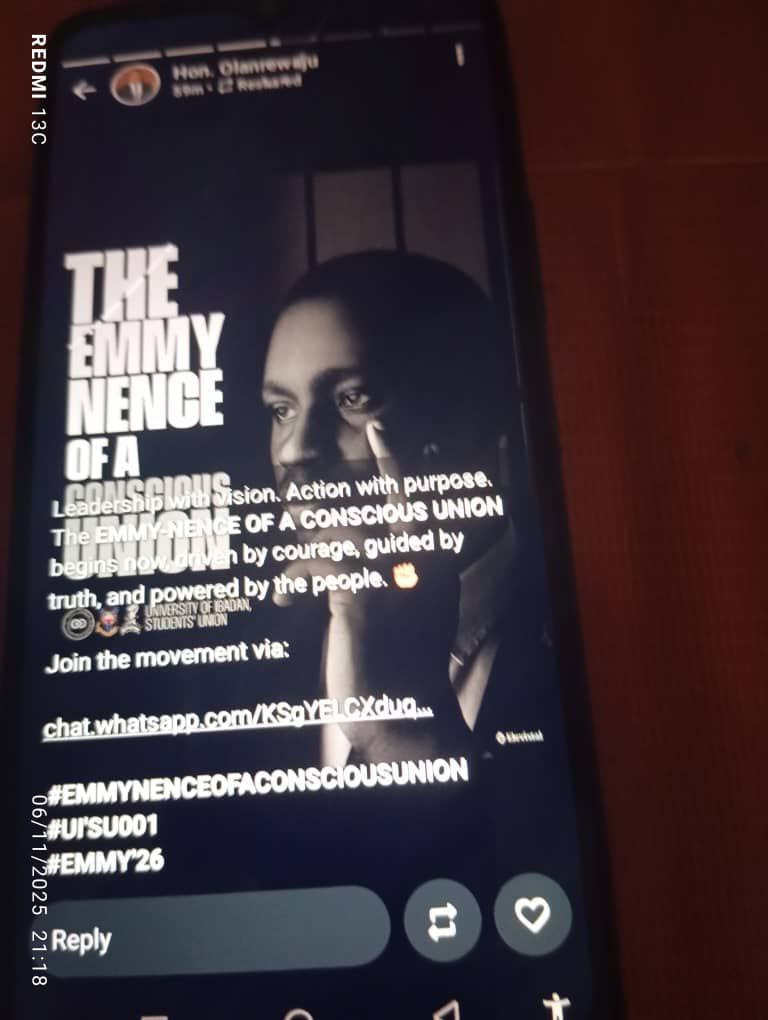
The Chairman of the Disciplinary Committee, Hon. Olanrewaju Basit Olatunde, who currently presides over the case involving the Students’ Union Assistant General Secretary (AGS), Emmanuel Olawoye, was seen doing what can be said to be a public endorsement of the same individual through a campaign post on his WhatsApp status.
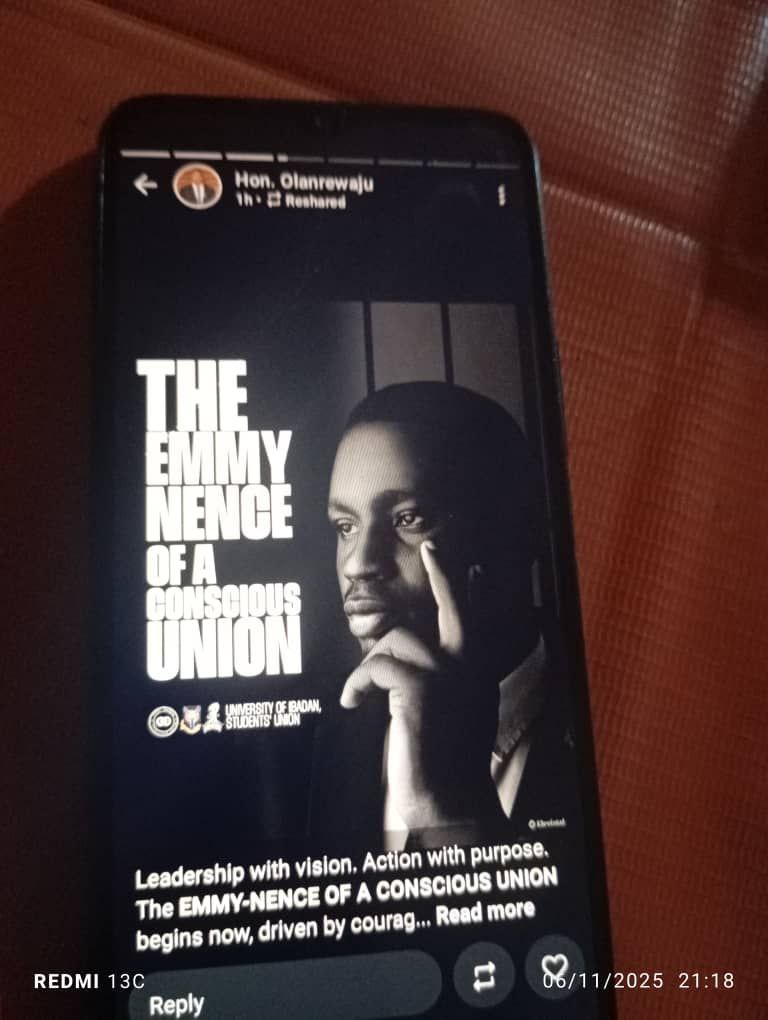
On 6 November 2025, several University of Ibadan students (UItes) noticed a WhatsApp status update from Hon. Olanrewaju, who had reshared the campaign graphic of Emmanuel Olawoye, the AGS of the Union, currently facing a disciplinary investigation over alleged financial misconduct during the Union’s Freshers’ Week event.
The post captioned “Leadership with vision. Action with purpose. The EMMY-NENCE OF A CONSCIOUS UNION begins now…” and branded with the University of Ibadan Students’ Union logo, features Olawoye’s campaign for what is assumed to be the presidency of the Union.
The Case Against the AGS
Earlier reports by the Union of Campus Journalists (UCJ UI) and other press organisations detailed allegations of financial misconduct against Emmanuel Olawoye concerning funds disbursed for the Freshers’ Week held in May 2025.
In total, the finance-approved budget for the entire Freshers’ Week was ₦4,666,460. The Project and Monitoring Committee reported an actual spending of ₦2,856,810. But the AGS claimed an unsubstantiated total expenditure of ₦4,376,360 was spent.
Olawoye’s records reportedly contained inflated figures for logistics, graphics, DJ services, and canopy rentals. On one event day, only ₦5,000 was confirmed as spent, while ₦190,000 was claimed to have been spent.
The matter was referred to the SRC Disciplinary Committee, chaired by Hon. Olanrewaju Basit Olatunde, for investigation and possible sanctions.
When the Judge Becomes a Campaigner
Ordinarily, the head of such a committee is expected to maintain strict neutrality until the conclusion of investigations. Any public display of support for a person under scrutiny undermines both the appearance and reality of fairness.
By resharing Olawoye’s campaign materials, Hon. Olanrewaju not only blurred the line between adjudicator and advocate, but also cast doubt on the committee’s objectivity.
For many UItes, this is very troubling. If the person presiding over a case is openly campaigning for the accused, what confidence remains in the outcome of that investigation?
The endorsement could easily be interpreted as pre-judgment, a public signal that the AGS is innocent or “fit to run,” even before findings are released.
By publicly resharing Olawoye’s campaign materials, Hon. Olanrewaju effectively aligned himself with one side of an ongoing case, suggesting bias or at least a lack of discretion. Such conduct can easily lead the student populace to infer that the accused is already exonerated, after all, if the “judge” is publicly endorsing the accused, doesn’t that imply confidence in his innocence?
Implications for the SRC
This development risks damaging the credibility of the Disciplinary Committee and the SRC as a whole. If the AGS is eventually found guilty, the Committee would face questions of bias and competence. Even if cleared, the fairness of the process may still be questioned due to the chairman’s prior public support.
For a body designed to mirror the judicial branch of government within the Union, such an action represents a significant ethical breach. The SU Constitution demands impartiality and integrity from those entrusted with disciplinary powers.
The Bigger Picture
The Disciplinary Committee is meant to safeguard the moral backbone of the Students’ Union. When its leaders are seen taking political sides, the entire structure of accountability wobbles.
The incident involving Hon. Olanrewaju Basit Olatunde highlights a critical need for clearer ethical standards within the Students’ Representative Council. The line between participation and interference must remain intact, especially for those tasked with upholding justice.
The University of Ibadan’s student community deserves confidence that no political allegiance, friendship, or ambition will cloud the judgment of its disciplinary body. Until then, this episode stands as a cautionary tale that even within student politics, the appearance of impartiality is as important as impartiality itself.