By Agara Bibisoluwa
“… UNIBADAN, first and best
…For a mind that knows is a mind that’s free”
Boluwatife, like many of his peers, embarks on a sporadic anthem recitation ritual. Although his rendition, a medley of incoherent mumbles and synchronized nods, he never fails to raise his voice, even louder than those that know what they are reciting, once the recitation gets to these two opening lines.
While the rest of the anthem might as well be written in an alien language, there is no way in the seven hells he can possibly forget these two lines that resonate well with his bragging rights as a Uite. These lines are his badges of honor as a student of the University of Ibadan, the apex of academic prowess where the waters of knowledge flow deep, freeing minds from the shallows of ignorance.
But before we delve deeper, let’s take a leisurely pause and exchange “greetings” with UI in the most proper and refreshing manner.
The Beautiful Bride
The University of Ibadan, UI as fondly called, stands as an institution that has shaped the nation’s identity and garnered immense pride since its founding seven decades ago. With a three-quarter century history steeped in tradition, culture, and unwavering excellence, UI’s values are deeply rooted in knowledge and academia, as echoed in its motto, “Recte Sapere Fons,” signifying “For Knowledge and Sound Judgment.” Uites, as the university’s students are called, staunchly defend its seven-decade honour, often with the chant of “First and Best!”
UI Anthem as an Embodiment of her Identity, Pride, and Mission
Among UI’s sources of pride, its anthem holds a special place. This anthem is not just symbolic; it resonates with a melodic resonance. Crafted by the gifted minds of Isidore Okpewho and Olaolu Omideyi in 1988, the anthem encapsulates the core values and mission of the University of Ibadan. Whenever it is sung at events or during official functions, it effortlessly fosters a sense of communal identity, unity, and pride among the students. Despite comprising only two verses, UI’s anthem conveys a robust message about the institution’s academic prowess and standing.
The Lyrics of UI Anthem
Verse One
UNIBADAN, fountain head
Of true learning, deep and sound
Soothing spring for all who thirst
Bounds of knowledge to advance
Pledge to serve our cherished goals
Self-reliance, Unity
That our nation may with pride
Help to build a world that is truly free
Verse Two
UNIBADAN, first and best
Raise true minds for a noble cause:
Social justice, equal chances
Greatness won with honest toil
Guide our people this to know:
Wisdom’s best to serve turned
Help enshrine the right to learn
For a mind that knows is a mind that’s free
The Gain and the Loss
The journey of the University of Ibadan from its inception to the present day has been nothing short of remarkable. It has risen above and beyond expectations, evolving from being just one of many colleges under the University of London to becoming a globally renowned institution. Throughout its existence, UI has cultivated a rich culture and traditions that have shaped the unique experiences of its students. From the inception of the Jaw War contest in 2014 to the vibrant student governance structures and the dynamic make-up of student organizations, faculty, departmental, and hall weeks, UI has forged a thriving student community. It has become a source of identity and pride for all who pass through its gates.
However, amid the gains and progress, there exists a loss – the gradual fading of UI’s cherished anthem from the collective memory of its students. Today, when the University anthem is played, discomfort and a hint of embarrassment ripple through the student body, as they discreetly glance around to ensure they are not alone in their ignorance. The stark reality is that a significant portion of the student population, spanning all levels, is unfamiliar with the school anthem. Among those who do, their knowledge is often limited to just a few lines, especially the closing one: “For a mind that knows is a mind that’s free.”
Oyindamola, a student of law at UI, encapsulates this prevailing sentiment. She candidly admits, “I only know a line or two of the anthem. The part about Unibadan being ‘first and best’ and the last line. I think everyone knows the last line because, during the anthem recitation, you witness fellow students who have been mumbling suddenly open their mouths wide at the final line, as if struck by a revelation.” In response to her feelings about this, she adds, “Is it embarrassing? Yes, perhaps. But I don’t feel ashamed for myself or for those who don’t know the lyrics. Instead, seeing fellow students mumble like I do brings back memories of our secondary school days. At that moment, what matters most is my deliberate effort to stifle the laughter welling up inside me.”
Another student who is in his penultimate year from the department of sociology shared the same view as Oyindamola. To him, “I didn’t bother learning it. I didn’t see the need to. Whenever there’s an event and the song is played, I just keep my mouth shut. They don’t really promote singing the school anthem.”
Speaking in similar veins, a fresh student from Obafemi Awolowo hall who pleaded anonymity, added, “I know part of it. I heard it at the matriculation ceremony and the freshers orientation. I don’t think it’s important. It’s not like we sing it everyday.”
In a somber tone, another student, Oreoluwa, lamented, saying, “I don’t even know what it sounds like. I don’t Iever heard it sung. Thinking about it though, it makes me feelbad”
It’s noteworthy that in lower levels of education, particularly at the secondary school level, school anthems are routinely sung right after the national anthem. By the beginning of the second term, virtually every student can recite their school’s anthem by heart. Considering that most tertiary students have at some point sung their secondary school anthem by heart, it’s disheartening to observe the relatively small percentage of Uites who are unfamiliar with UI anthem.
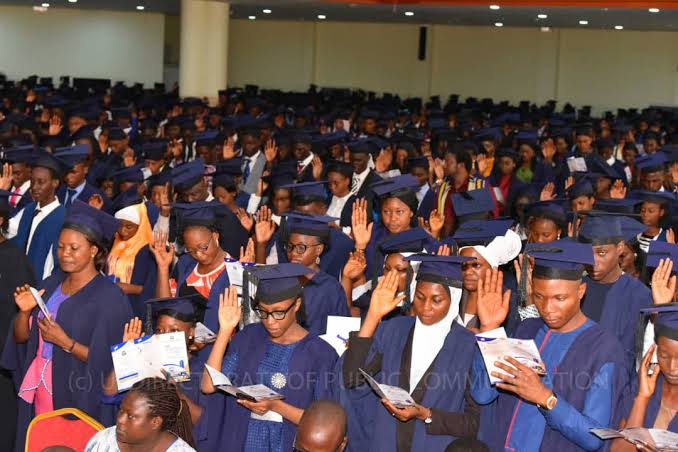
Typically, when a university event commences, it begins (or ends) with renditions of both the national and school anthems. These anthems are played through speakers. During the national anthem, the halls resound with melodious voices echoing the familiar lyrics. After years of exposure to the anthem, it’s a rarity to find a student, regardless of their level of education, who cannot sing the national anthem.
However, following the national anthem is the school anthem, and at this juncture, the participants often come to realize the vocal prowess of the University of Ibadan choir. For most of the anthem’s two verses, the voices emanating from the speakers tend to be the sole audible ones throughout the hall. While this underscores the choir’s talent, it also highlights the unfortunate reality of how little students know about their own school anthem.
The Motivations/Causes
Speaking on the motivation for this, Oyindamola observed that “while it’s no excuse, I don’t think students get to hear this anthem often. You only get to hear it sang at school’s functionaries. And these occasions don’t come often. So, it’s to be expected that due to low publicity of this anthem or students’ exposure to it, they will barely get to know it.
“This is not the same with secondary school where they get to recite some of these every morning at the assembly ground. Looking at Nigeria’s anthem. I’m beginning to forget some of the lines because I don’t get to hear it as often as I used to back insecondary school days.”
Another student, Toyosi, commented that there are no incentives to learn as It’s not mandatory. While the ignorance and nonchalance regarding the matter is somewhat disappointing, most interviewed sudents believe that the school is somewhat responsible for this.
As observed by one, “the school anthem was never a part of our school traditions, neitherwas it mandatory to learn. Some student go through a four-year course and only hear it twice (at their matriculation ceremony and their graduation ceremony).”
Going Foward
While the majority of students do not know the anthem by heart, not all fall under this category. For instance, Gift, a final year student said she could sing the school anthem although she would prefer to have the lyrics with her when she sings it. She explained that she and her classmates had to learn it for a linguistics course. However, not all Uites get to have the Anthem incorporated into their curriculum like Gift.
To reverse this trend, the school management can implement regular anthem recitation sessions during important events or assemblies. They could also create engaging multimedia content such as videos or audio recordings of the anthem and share it on various platforms for easy access.
Additionally, organizing anthem singing competitions or incorporating it into the curriculum can help students familiarize themselves with the lyrics. Collaborative efforts with student organizations and alumni can also instill a sense of pride and tradition, encouraging students to learn and cherish the anthem.
Note: some names were changed.