-By: ANUSHIEM CHIDERA
Before delving into the crux of this article, it is important to revisit the rather unexpected announcement of June the 12th as the national democracy day and investiture of some individuals with national awards. This is done, not because it is necessary to do so but because 25 years down the line — and less than one year to the eighth election ever held in Nigeria, we are not close to reaching the heights that the election of June 12, 1993 ever portended for the nation.
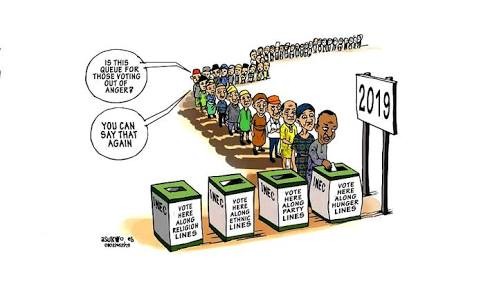
The stage is almost set. The dramatis personae who would be involved in the 2019 script are getting ready; the clouds are preparing to break the day of election to 200 million Nigerians; the hopes of the hopeful few have been raised again, and the doubting Thomases continue to do what they know how to do best… doubt. Thus, as the elections approach, it is important to examine what each candidate brings to the table.
MUHAMMADU BUHARI
Drawing the curtain on his first term of his second coming to the corridor of power after 3 futile attempts, it is no longer news that the septuagenarian has decided to run again, just weeks before signing the Not Too Young To Run bill into law. How ironic. Under his watch, animals have done more than Nigerians can do, recession has bitten more than Nigerians can chew, and comments have emanated from the ‘ogas at the top’ more than we can imagine.
In more than three years of government, the Muhammadu Buhari-led administration can attest to the fact that they promised a long list of things before ascending the throne at the Villa. They can also attest to the fact that the majority of this long list of promises remains to be fulfilled, even though they say otherwise to the public. As I have once heard a man observe, the Buhari campaign team might have a hard time convincing Nigerians on why they should be given a second mandate because like the foolish servants in the Bible, the investment Nigerians put into the government in terms of voting and enduring unbearable hardship has turned out largely unprofitable.
But again, this is Nigeria, where the power of incumbency in determining the outcome of an election is only second to the power of the Creator. Campaigners can campaign, strategists can strategize, and givers of rice and caps can give, but the powers that be lie in wait to strike. It is then up to Nigerians to decide how effective their expected strike to be.
Beside the aforementioned, the internal crisis that currently rocks the sea of the ruling APC is one that if not managed will cause great harm to Sai Baba’s chances of emerging. Perhaps this was what prompted him to recover Asiwaju Bola Tinubu to the fold, suspecting that if it was overlooked, it could be more harmful than innocuous. The APC’s crises are justification of the maxim that absolute power corrupts absolutely. Before taking over power, the APC looked like the messiah that would lift Nigeria from the doldrums of ignominy to the pinnacle of celebrity but upon the ascension to power, the unrelenting witches of Aso Rock have torn the fabrics of sanity that once clothed the party, and it remains to be seen how it affects the chances of their almost-certain candidate at the election.
KINGSLEY MOGHALU
Highly decorated and with all the accolades the Office of the President of the Federal Republic of Nigeria needs, one would describe Moghalu as one who has the ideas and oratory acumen to back them up but lacks the ‘street credibility’. He comes hoisting the emblem of the Young People Party (YPP). Moghalu is at best qualified and at worst has not swum in the muddy waters of Nigerian politics. He has so far highlighted the need for visionary leadership but has not taken time to meticulously articulate his plans for a new Nigeria in the language that is audible to the deaf and visible to the blind.
In addition to that, the truth is a bitter pill to swallow. But he who must swallow it must recognize that before a man can make it to the Villa as President, he or she must be wholly welcome among the Southerners and favorable, to some extent, to some northerners. As such, the truth remains that winning the Presidential election is beyond erudition—it deserves some level of brilliant regional strategy, something to which Moghalu does not boast of.
ABUBAKAR ATIKU
‘Waziri of Adamawa,’ as he is popularly called, is one who needs no introduction. His resilience and determination to be President of Nigeria is known to all. As Vice President from 1999 to 2007, allegations of corruption and an unending stigma of being unable to travel legally to the United States have appeared to be stains that have refused to be washed off his reputation. In his numerous speeches and press statements, the septuagenarian has stated that he remains committed to restructuring the nation within six months, fixing the economy by producing millions of jobs, revitalizing the nation’s ailing educational system, and eliminating insecurity once and for all. He has also promised to contest for the last time in 2019. And that, too, depends on the outcome of the elections.
Perhaps the turn off when it comes to Atiku is his unfounded and endless defections between political parties. Between the period that he contested under the platform of the PDP in 1999 till date, it is calculated that Atiku has switched political parties nothing less than seven times. And this portends desperation for him in the eyes of people. And a desperate man, they say, bears no good omen.
That is not to say, though, that the man from Adamawa does not stand a great chance of winning. However, as a northerner, President Buhari wields a lot of following, and as such, he might be difficult to displace from that stronghold. The best bet for Abubakar and his atikulators would be to beam their political searchlight on the South, do their best, and hope that the North produces something substantial to help Atiku’s case.
OMOYELE SOWORE
The 47-year-old publisher of the popular media outfit, SaharaReporters, is one who is familiar with the dispositions, propensities, and needs of the common man. His time as Student leader at the University of Lagos counts as leadership experience. However, one does not go to a war with the experience of a previous argument. He needs more than that. And so does Sowore. His experience as Student leader counts as nothing when considering the office of the number one man of the Federal Republic.
Another let-down which Sowore faces is his unpopularity in the Northern states. His campaigns have largely targeted the south-west, leaving out the outer geopolitical zones. And in the race for the presidency, it is as clear as day that basing a political campaign on the strength of one of six geopolitical zone is as inimical as the venom of a King Cobra.
FELA DUROTOYE
Like Sowore, Fela provides a young option for the nation to explore. However, again, like Sowore, he has decided, rather strangely, to base his campaigning on the strength of the South West, a region which is already so competitive that he might not stand a chance. Not only that, he has consistently iterated the importance of the religious undertone of his campaign in a nation with such religious complexities as Nigeria. Religion has never won elections in the past, does not win in the present, and will likely not win them in the future. The earlier this fact is realized, the better for the campaign and for Fela.
In conclusion, it is trite knowledge that the 2019 represents a pivotal point in the actualization of the Nigerian dream. If we get things right, we can put Nigeria back on a continuous travel down the boulevard of prosperity; and if we get them wrong, Nigeria may be thrown into the bottomless pit of stagnancy for a permanent residence, and that is the last thing any Nigerian wants.