It is hard to be an Awoite at the moment. Many Awoites right now think they have offended some ancestors of the hall, and this is not for a reason. Sometime, early July, the Union of Campus Journalists set out to assess the living conditions and state of facilities in all undergraduate halls of the university after the over-200% increment in accommodation levy. However, while other halls have seen significant changes, (Mellanby and Indy got brand-new Water Closets; Queen Idia hall got a ‘facelift’ as described by the Vice-Chancellor; Bello hall got new doors and locks; the list goes on and on) Awoites still await fortune to smile on them—unless things have changed at the time of filing this report.
As a result of the changes experienced in these halls, a second visit was paid to the hall to ascertain the situation of things. And, with the help of another guide, Chidera Anushiem, UCJ Politics Editor, compiles this report based on the same blocks he had visited the first time: blocks A, B, C, D, F, G, and I.
PRAISE FOR THE HALL MANAGEMENT
In the last visit paid to the hall, blocks A, B and C were looking like the blocks of a proper hall of residence. For residents of blocks A, B, and C, there is still a lot to cheer. Facilities in these blocks are still manageable, compared to others, and the locks of most rooms are still intact. The nets of most rooms are still in good shape and occupants of these rooms enjoy manageable bathrooms and toilets. For residents of block I, the situation is much better.
Block I, a block for post-graduate students, recently refurbished, is the only block that represents what a hall of residence should be. Near-perfect neatness, good condition of facilities and the glitter of new paint characterize the block. The block, which was fixed last semester and commissioned by the Vice-Chancellor in June 2018, is the only flashpoint of sanity in Awo Hall. In other blocks, the story is different.
Also, as opposed to the disturbing frequency with which it occurred last session, members of the Security Department of the University do not have to visit the hall to settle significant cases of theft and skirmishes among residents.
SPOILT FACILITIES REMAIN SPOILT UNTIL STUDENTS FUND THEIR REPAIR
During the last visit to the hall, occupants of the hall complained of how they would have to fund the repair whenever facilities — such as door locks and nets — got spoilt, with the porters only providing the artisans who ensure that the job gets done. Unfortunately, an extra 72 days after the compilation of the earlier report, things have not changed.
In the visit that preceded the last report, Halimat*, a resident of block G, informed this reporter that she had gone to the Hall Porters severally to complain about the poor state of her room’s locks but all her pleas were met with deaf ears. Eventually, she contracted a carpenter—which is against the University regulations—to help fix the lock. The carpenter in his own benevolence decided to take up the case. He personally visited the porters and upon request, the lock was given him and Halima did not have to pay a single dime.
For others like Samantha and Tolani, however, the narrative was different. According to their very similar testaments, “after we visited the porters to give us the locks, they just gave us and asked us to go and fix them on our own. And so the only reasonable thing was for us to hire a carpenter which we paid to help us fix it.” Despite paying accommodation fees, these ones and many other unheard people still had to pay for their own security. If their problems ended there, things would have still been bearable. Alas, that is only one of many.
ROOM NETS, KITCHENETTE NETS, TOILETS AND BATHROOM NETS REMAIN IN THE POSSESSION OF THE FORCES OF WILDERNESS
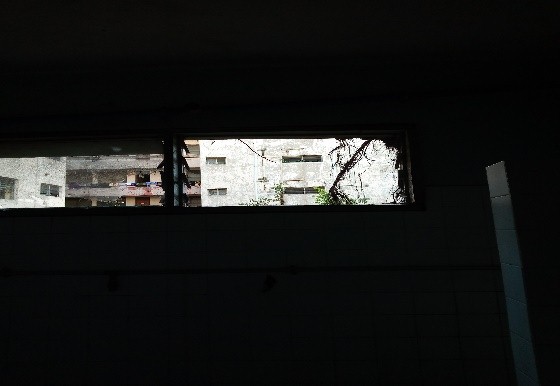
 The last time the UCJ visited the hall, the nets—especially for blocks D, F, G and H—were at large. Upon the next visit, they were no significant changes either. For Awoites in block G and H, particularly the first floor, the bathroom window is conveniently the easiest way to commit suicide. The nets are almost entirely off, they seem to have been off for a long period of time, and they look like they would be off for even a longer time. So when one feels tired of life, one could easily dial their ancestors through these nets and they can rest assured that their calls will be promptly taken.
In Block D, the situation is quite similar. Of all five bathroom nets, only two seem to be in good 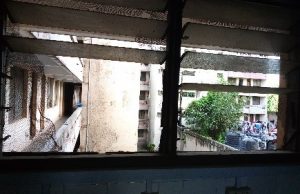 shape: the net covering the first floor is covered by all sorts of vegetation; that of the second floor has mild bruises; that of the third floor has the greater part of its net in the hands of kidnappers with plants taking the place of nets. Those of the ground and top-most floors still maintain a relatively high level of sanity.
The kitchenettes are also not left out by the wicked forces. In block F, kitchenettes’ nets have gone to sleep. Instead of being the membrane that guides what goes out and comes in, it is a free passagehole for what actually WANTS to come in or go out in a room where the foods that people eat are being prepared. For almost all floors in this block, at least one net of every kitchenette is down to muscle tear, and they can only look on and see from whence their help shall come.
If one asked a child what the function of room window nets were for, the child would most likely argue in the direction of protection. But in Awo hall, reverse is the case. For occupants of block H, there exists a prefect ecosystem: plants are found lurking around their windows, animals have gotten an entry visa from their nets to gourmandize with them, and humans are the hosts to these visitors. Well, should there be a need to change these nets when humans, animals and plants relatewell? Maybe not.
BATHROOMS REMAIN POOR ARCHITECHTURALLY AND COSMETICALLY
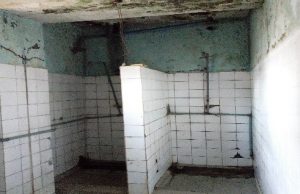 For almost all blocks in the hall (save for block I), the bathrooms are nothing to write home about. To put it simply, these bathrooms are unbefitting for human use in the 21st century. Sights like the bathrooms serving blocks D, F, G and H are probably what pushed KunleAdebajo to describe our Halls of Residence as ‘decrepit vestiges of colonialism’. These bathrooms are not in the best shape, have leaking rooftops, and do not resemble where humans go in to have their body parts cleaned up.
When it is not the case of bad bathrooms, it is that loos and bathrooms are designed with exquisitely beautiful architecture that thinks it wise to build bathrooms directly opposite rooms. Students constantly live with the consciousness that the odor of feces — which can sometimes be too offensive to bear — can pervade the air or disturb their reading, or, more painfully, destroy the quality of their food. One would hardly imagine that these are people who paid as high as 30,000 naira to secure accommodation. Make no mistake about this: the preceding statement does not indicate the end of their long list of woes.
AFTER 72 DAYS, ALL IS STILL NOT WELL WITH THE WELL
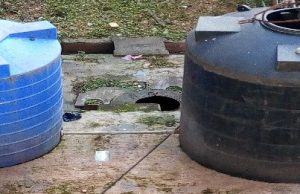 One of the wells serving residents of this hall has not experienced any level of wellness over time. It is the constant party house for organisms of various species — bacteria, fungi, rodents, plants, and others. The criterion to be able to attend these parties is an ability to get into the well. You’re able to fit yourself in, you’re in. No lid, no covering. Nothing. According to the account of an Awoite, ‘these are wells we draw water from when there is no water in the hall. And the sad thing is that the well has no covering whatsoever.’ When someone, after having paid the compulsory sum of 30,000 naira, is expected to have her bath with water drawn from an unwell well, the sanity of such society should be questioned.
Existing just ahead of the well is a mini-gutter …close to students’ source of water. The 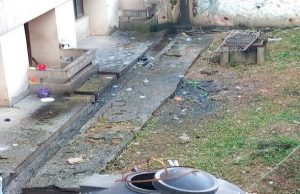 arrangement is clear: the gutter invites the rodents, cockroaches, mosquitoes and others to the party that goes on in the well, after the party, Awoites consume the left-over with the water. Beautiful organization.
In addition, sundry gory sights were observed, especially with the kitchenettes and the walls. These walls had sagged from a consistent shower of water in its various forms — foamy, clean, dirty, and muddy. The kitchenettes were not left out too. Extremely rusty hot plates were found littering the kitchenettes; bad sockets were the norm and spoilt food was obvious in their numbers.
LATE ARRIVAL OF POWER, EARLY EXIT OF SAME
In science, especially physics, it is taught that the speed of light is about 300000000 metres per second. However, in the University of Ibadan, the light travels so slowly that one would think that light had become a snail (for even a snail wouldn’t take as long as light does to get to Awo hall from the Central Administrative Area), or that the changeover switches that serve the halls are in different geopolitical zones of the country. Residents of the hall pay the same thirty thousand Naira — and sometimes more — as occupants of other halls, but, unfortunately, it is noticed that while fellow students in the halls of residence around the Central Administrative Area are supplied with power earlier, Awoites often get supplied about two — sometimes three, four —hours after their colleagues in the CAA. And when it comes the time for the Power Holding Company of Nigeria to hold back their light, they do so at exactly the same time for all halls. Late arrival yet early exit of such lights. In the words of Saa, ‘we await the day that light would travel at its speed in UI’. For Chinwendu, she consistently wonders why Awoites pay the same amount of accommodation levy because, according to her, ‘we have the poorest water supply, the latest arrival of power, and the worst of facilities’.
WAY FORWARD
It cannot be gainsaid that the best way to tackle any problem is by first addressing its origin. And the origin here, if we must be sincere, is the heavy pressure placed on infrastructure in the hall, without adequate maintenance measures put in place to address the effect of this pressure on the facilities. And so as a matter of urgency, the onus is on the University management to wheel Obafemi Awolowo Hall into the operating theatre and perform the cosmetic surgery required to return Awo Hall to its true status as one of the giants in Sub-Saharan Africa.
TO ROUND OFF…
As was stated in the earlier report, it is often said that only God keeps flies away from the body of a tailless cow. When money cannot fix the problems facing a people (which represents the tail of the proverbial cow), they have only two ways to go: their God or wherever else they deem fit. And in this case, it is up to Awoites to choose where they intend to seek the solution to the decay of infrastructure in Obafemi Awolowo Hall.
*All names used in the compilation of this report have been falsified, on the strict demands of the respondents.