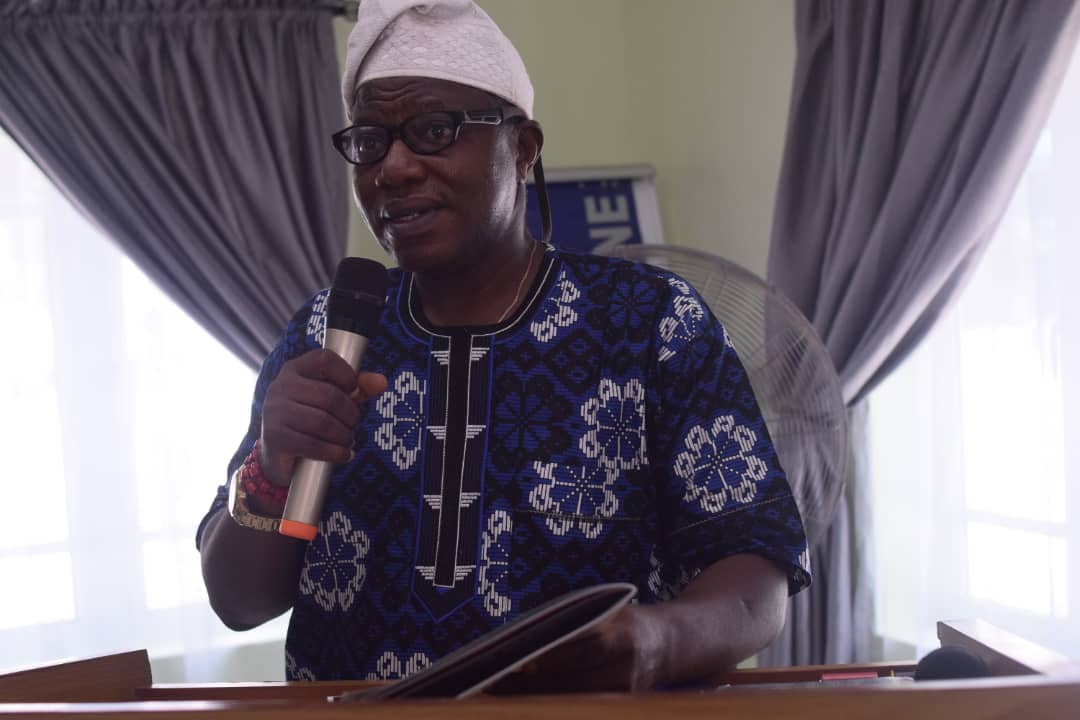
Language, Literature, Security Crisis and National Development
Being the Text of Professor Raji-Oyelade Personality Lecture
delivered by
Ndubuisi Martins Aniemeka
University of Ibadan, Nigeria
ndubuisi_aniemeka@yahoo.com
at
The Southwest Conference of Students of English and Literary Studies (WESTCOSELS 2021) held on the 8th of April, 2021 at Ilaji Hotels and Sports Resorts, Akanran, Ibadan
Preamble
When my teacher, mentor and honoree of today, Professor Aderemi Raji-Oyelade, recommended me to give this personality lecture, something churned, perhaps your guess is excitement and that too would be fine, for no money goes in stake. Again, could it be some fear as to avoid this? No, far from it. I felt the threefold emotion of happiness, shock and nervousness. Happy that my teacher who is in touch with many other students of his, nominated me to give this talk that I know many other folks would lobby for. Shock would again relate to the first, thus touch on the fact that I least expected it. But, am I prepared for it? Yes, because I have taken to the ancient wisdom of my teachers, Professor Raji-Oyelade inclusive, who always reiterated preparation as key to utilising opportunities that can fly into one’s nest as a bird, in the day or at night. The last is am I nervous? Yes, because everyone, having to give a talk, experiences the nerve prompts on the day. Why am I telling you this? This is because you will find yourself happy, shocked and nervous when the baton is handed to you. But, you may perhaps be lucky to have a great mentor and patron, so ask Professor Raji-Oyelade to give you a leaf from his many thought-provoking points of presentations.
To quickly come to the topic, let us take some relevant poetic quotations, first because the honoree is an accomplished internationally recognized poet and second because I am following in his footsteps. We quickly take tosin gbogi’s locomotif and other poems , which is aptly selected for its relation to the theme of WESTCOSELS 2021:
i sing
I sing of a land
Becoming an orgasmic bed
of climaxing crimes
chimes
the clock taking on the intermittent
silence of graveyard spades
moonsong, cluttered in clouds, buried
twilight, doomed, scattered
amidst two tantalizing doubts
bye bye bye bye
(page 32, locomotifs and other poems, 2018)
I will not want to bore you with needless details, but will attempt to offer some ideas that perhaps would cover the main points of your conference. I intend, to where possible, make this dialogic. I would earnestly commence with posers that revolve around your theme.
Which of these, or combinations of these realities represent the Nigeria of WESTCOSELS and one for us all?
People who magnify or simply their multi-faceted problems
People who are unaware of the problems that beset them so that they are unbothered.
People who feed their lingering problems with silence.
People who speak about their problems and seek active solutions to them
People who appear generally helpless and live like they have no problems
Is security and national development more about the use of language or the signification of language as an active reflective mode?
Alternatively, can language and literature save Nigeria from the grip of herdsmen, book haram and banditry?
Would language stretch the elasticity of writers’ demand and supply, and all WESCOSELS to make for economic sufficiency?
My lecture would not delve into all these posers, in the main, but there is the possibility of inferences from it.
Taking another careful look at the posers, again, we may begin to see that the topic of our reflection produces the kind of connected conflicts that define it. The first is what language would do to reduce the crises that bedevil Nigeria, more or less different from what strategic intelligence of an army general and other security chiefs can bring. Again, the idea that a novel, play, or poem can settle flaring nerves would present some doubts to people who have ingrained scientific remedies to the ravaging insecurity that daily put Nigeria on the inglorious global attention.
In many ways, negotiations of the keywords: language, literature, security and national development engender both theoretical and pragmatic posturing of ideas. In theoretical frames, linguists and literary scholars make panel sessions of these concepts and papers are generated from such discussions. But the key questions that I pose to no one in particular are: where do these robust debates eventually go to? How have we deployed these coherent presentations to halt the progressive decline of our nation? Will the WESTCOSELS CONFERENCE be any different from the DIPLOMACY of other academic exercises?
Without especially being pedantic with any of the key terms, I would want to devolve the discussion and generate some relevant details around the concepts “language” “literature” “security” and ‘national development.” In doing this, I would not seek to restate definitions of language which have produced the difference of conflicts or the indifference in conflicts. I will relate the mechanics of language, as some centric force, and where necessary only serve the description of the relationship it holds with literature, security challenges and national development, all of which are specifically and mutually implicated as language in contexts – and literature as its imaginative extension.
On Language
Language accrues to every language-enabled human, such strategic systematic and pragmatic positioning and privileges, so that at all portals of spoken and written communication, man would mean to another man. This is possible because there is a linguistic commonwealth that if rightly combined by simple or complex structures, can foster socially-shared linguistic codes and literary meanings. Central to the use of language is human understanding or limitation with contexts and handling of meaning transactions. The elasticity of meaning is possible with misplacement of signs and codes, and these, put together, have effects on conflict emergence in any human society. What do I mean? A user of language strives for utmost clarity, so that meaning is not misplaced or willfully amputated through either the ignorance of the decoder or the gleeful extension of one not thoroughly perceptive of underhand insinuations.
How can meaning behave in a heterogeneous society?
Without its multilingual and its multi-ethnic characteristics how much of commonality in “language” is the experience in Nigeria? Many critics are quick to the opinion that the heterogeneous character of Nigeria is a big problem and its multi-ethnic expressions mean that chaos cannot but recur in meaning exchanges between people of diverse languages. To these people one could ask an important question; does mono-culture prevent security challenges and advance development? The complex human nature regardless of ethnic and global thinking, the individual peculiarities in encoding, interpreting and feedback are barely considered in making these claims. For people who advance the mono-ethnic thinking as a counteractive point to solving conflict situations in multi-cultural societies, there should be aware that the plural character of societies around the world could have suggested to them the fallacy in their mono-cultural claims. Universal language and culture barely exist in a global world where meaning is as plural as the cultures that express them. America, with all its challenges – the most nagging being race and race relations – have surmounted the basic developmental issues. The key question can also be: did language play its role in that developmental experience? That may be subjected to a robust analysis beyond the personality lecture. All that seems reiterative, perhaps, is that meaning is everyone’s playfield of interpretations and reinterpretations, for many interlocutors bring the complexes of their socio-cultural leanings into its meaning. This is so much that language is affected by physical, physiological factors and psychological factors.
As a new primary student in an Urhobo town, specifically at Delta State University Staff School, together with my cousin, I had gone to buy groundnut, because in Ibadan – where I had lived for some time, it was called ekpa and I had momentarily forgotten that I was not in Ibadan, so on mentioning that I wanted ekpa, the face of the middle-aged woman changed and she hurled insults at me, indicating in Urhobo that it was in my family they sold ekpa. I was hurt by her behavior, but in actual fact, was it her fault? No. It would be that which points to meaning dislocation.
The heterogeneity of languages would necessarily mean such corresponding heterogeneity of meanings. Thus, human beings are meaning producers and carriers. A clear understanding of how meaning works means that people can anticipate, manage and cope with the myriads of challenges of use in contexts. One influential agency in language and meaning context is the media.
The Media: In the Service of Language
Language used by people fosters cultural and social understanding, in the same way it can produce conflict. Many people depend on mass communication to receive information that shapes their lives. This is why the media and language use across its space become crucial at this point. There is a curious link between how language is deployed by mass media and how the spatially dispersed audiences react to the meanings projected across media platforms – print and electronic, as well as social media. This is so that, in conflict situations, within its interpretive mass disseminating contexts, the media ought to direct attention to responsible journalism. It ought to be the grounds that professional journalism is practised. What this means is that the media authorities have the city to entrench a culture which advances a proper understanding of conflict reporting nuances that can delimit unwieldy reception that may arise from news. The media has a key role in deploying language in reporting security threat and sharing information in a way that is responsible. Much documented in a body of literatures is the role the media play in averting security. Odigbo (2003), argues that they “(mass media) watch over, guard and alert society of impending problems and often proffer the way forward.” In aptly serving the society and preempting conflict situations, it is thought that the media are charged with the responsibility of covering, analysing and reporting impending dangers that are a threat to the lives and property of a given society ( Udeze and Chukwuma, 2013).
Another major role that the media play is in relation to surveillance. Surveillance means a process of retrieving and disseminating information about local, national and international happenings and situations. In relation to this, the media provide some security information before such threat materialises. For instance, it was reported in the media, by CNN a few months back, that AL-QAEDA and ISIS would infiltrate some parts of southern Nigeria and wreak havoc in some places. The language in which the media reported that threat was sacrosanct, and one may not know how security forces must have reacted to that surveillance report by the media. It is also through that a large part of our security conundrum is a function of fake news. The integrity of news and reporting has been compounded by the access people have to social media. This normally allows merchant of fake news to cause unnecessary security threats and reactions by some sections of the social media users who receive and redistribute unverified reports. A cursory check on such fake news reports would reveal careless language deployment and the most discerning people complain about this wildlife effect of media and language abuse.
One thing that is clear is that language engenders peace and amity and can also stir chain reactions. Through the social media in Nigeria, particularly on Facebook, Twitter and Instagram, we find that language sensitises, amuses and cries for help in the diverse uses many Nigerians put it to. The media persistently deploy language to inform people of pervasive crimes and threats posed by insecurity. It was through the social media handles of some youth enforcers and influencers that in October 2020, within the precarious season of COVID-19, ENDSARS movement began and spread through many nations, resulting in a movement of global dimension. The protest was against police brutality of the Nigeria Police Force, especially the Special Anti-Robbery Squad which had been formed to fight crimes but turned to unleash mayhem on the youth and other Nigerians. The irresponsibility of the security chiefs and the Nigerian government, meant that through actions, or inactions, eerie silence and improper language later caused escalation in that security situation which produced what was largely believed to be the Lekkigate massacre of youth on 20 Ocotober, 2020. Language was the force through which the youth pushed through various demands around the ENDSARS movement.
However, there is a real danger in the proliferation of unverified information spreading through some media handles, all the time. This also suggests that there is such a delicate affinity to language and the flight of meaning that is possible for the receiving audience. This is so that, on both sides – the media and its mass audiences, meaning transaction around the crisis may be limited or infinite if not adequately understood. In the context of reporting the tendency of the audience to misconstrue or misapply the media content on the crisis is possible, and this can be down to a poor understanding of language and its semantic implications In recent reports on banditry, we have had some news media accentuating ethnic tone and tonality, which on the strength of elasticity of meaning; can spell caustic reactions from the audience. Security is delicate in Nigeria, but the media would have to respond to the situation intelligently with appropriate language. Language, verbal and non-verbal, permeates all facets of life, including notions of security and insecurity.
Thoughts on Security and Insecurity: The Nigerian Experience
Security is related to minimal or absence of threats to the health and life of humans as well as, loss to the non-human entities, acquired and so serve a complex need for human peace and stability. This is so that literature on security posits certain factors that expose people and things to threats of injury and loss. Beland 2005; Achumba, Ighomeroho and Akpor-Robaro, 2013) all confirm that the state of or anxiety stemming from concrete or alleged lack of protection or inadequate freedom from danger is seen as insecurity. Perhaps, one exactly ramifies that the flip side of insecurity is security. It would appear that the concept of security shares a composite meaning relationship with insecurity. In their attempts at clarifications of the term, security, scholars have posited interesting perspectives to shed light on what may serve as epistemological points for further discussions on security elsewhere.
The presence of security issues in human society has necessitated perspectives that are hinged on points of emergence, valence and prevalence. The multifaceted nature of conflict means that no comprehensive records can fully capture its historical provenance. The earliest known ones are mostly communal clashes of the pre-colonial times, but scholars would argue that such incidents did not provide as much scrutiny as the security challenges of the post-war times of the world. Perhaps, a Google search on Nigeria, by anyone who is outside the country, would reveal its current, debilitating state of insecurity. The rate at which security crises in Nigeria has overtaken Nigeria is worrisome not to only language experts but also policy makers and social critics. Nwabueze and Ebeze (2013) posit that: once the word “insecurity” is mentioned while referring to Nigeria, the first words to come to mind are Boko Haram, kidnapping, Niger Delta Crises, and ethno-religious crises.” They go further to trace the provenance of insecurity in NiNigeria, noting that, before the assaults launched on the country in Boko Haram in 2009, there had been pockets of such security issues as the kidnapping of foreign expatriates by militants in the Niger Delta region. Niger Delta militants had advanced developmental exclusion as the reason for their violent attacks and abduction of oil workers and destruction of pipelines. At the time, the militants only confined kidnapping to the creeks until they extended their tentacles to the streets, posing severe security concern to even their people, regional governments and the Federal Government.
There had always been records of ethno-religious conflicts, resulting in reprisals in the North and other parts of the country. Security threats were rife in some parts of Northern Nigeria: Central and North East regions of the country, between such terrorist attacks, emerged and sustained, culminating in the abduction of Chibok Girls. That singular event marked the beginning of kidnappings, which now threaten the movement and livelihood of many a Nigerian. Churches, mosques, shops, cars and all other property have been damaged in the raging insurgency. More than thirty thousand lives were reported to have been lost to Boko Haram frequent raids. The Internally Displaced Persons (IDPs) camps now assume new shards of shelter for thousands of people who are victims of Boko Haram insurgency. Shortly before 2014, the normadic Fulani herdsmen made security complicated; first in Benue where they were alleged to have wrought untrammelled violence on farmers, raped their women and took over farmlands. The result of their occupation of forests and farmlands caused villagers to abandon their villagers in unexpected displacement and hardship. It is hard not to discern that insecurity in Nigeria, has become pervasive and for many years occurring as a language, for within and outside its fatal indulgences, it is produced by the facilities of language in contexts of history and reporting.
Today, in Nigeria, insecurity has come closer home, sweeping through everywhere, Imo, Enugu, Ebonyi, Delta and Edo; cases also abound in some Oyo, Ogun, Ekiti and Osun States. Some reports of recent killings and abductions of farmers, prominent chiefs and kings in Ondo State and Oyo State, vividly support the notion that our lived reality is insecurity. Some South-West leaders, despite some initial uproar from Abuja, have formed a supplementary security unit, Amotekun, to provide security to their people. It is also thoughtfully pertinent that the term, “Amotekun”, within the Yoruba worldview, has a curious figuration, as “leopard” is not a domestic animal, not also one that will allow all manner of intruders to cause mayhem in the southwest. I suppose, therefore, that the linguistic import of Amotekun, with its superimposing literary meaning must have unsettled some people in Abuja, who, initially, wanted to crush the security outfit when it was muted. It finally saw the light; perhaps, an instance that language is now squaring up against insecurity and might gain success against all threats. In this precarious situation, where many Nigerians exist in fear, one can imagine what development is possible? In other words, how foreseeable is the idea of national development?
National Development and Nigeria
Nations everywhere have lofty dreams for development. They strive in spite of teething challenges to fulfill developmental goals and indexes: “improvement in human well-being and quality of life” (Boutros Boutros Ghali, 1995). Interrogating the concept of development reveals that it engenders such ideals as a reduction in the poverty rate, safeguarding of fundamental human rights and freedoms. Are there the faintest suggestions that Nigeria is on the part of development despite being ageless, seen as “developing”? In his paper, National Development: Political Will the Missing Link in Nigeria, Chris Ojukwu(2010) avers:
The 2Ist Century has infused into diverse nations, races and peoples, new confidence about their future possibility, predicated, as it were, on the certainty of comprehensive empowering thematics of sustainable development and the practical pedagogy of regeneration. But for Nigeria, the picture is one of waste, dissipation and desolation. The economy is in shambles, suffering from multiple structural deformities…(pp.250)
Like Ojukwu, many opinion leaders and critics who are frank think of Nigeria as an old infant, resisting all attempts to grow and develop. As a child of three, having heard the cliché since then; more than three decades ago already, one of my cousins suggested in a tone of resignation that Nigeria will never develop. Pessimism might just be the unhelpful thing to now to. I perhaps would agree only if any can guarantee the next potential pessimist the timeline to keep their optimist touch from going dim. One wonders if Nigeria fulfills the characteristics of a nation, so that it would be right to dream of development that appears almost illusory to her. While development stresses qualitative transformation of life and living, when it relates to a society, one may predict what Nigeria becomes as it takes obvious pitfalls, and with little or no intention to leave the doldrums.
Can Language and Literature save Nigeria from insecurity and developmental crisis?
Perhaps, it is more suitable to first ask if metaphor can cut through a body like a rifle would do? You may consider the quotation particularly ambivalent, because the technology of imagination that produces metaphor is different from that which induces fear in anyone – the machine gun or AK47 – if even whispered, may cause a gathering of any people, big or small, affluent or poor, to summarily disperse to take cover under anything they can imagine..
In 2012 when he delivered the International conference’s keynote of the Association of Nigeria Authors, I note that, the late inimitable, culturally diverse scholar, and public intellectual, Professor Pius Adesanmi had first, found discordant the relationship between literature and security. Making rich allusions to moments and manners in which literature and security cannot belong together, he expounds, and tries to show how literature cannot foreclose anomie. His approach is sardonic yet contiguous on and to time-tested logic. But, would writers, afraid of the nuzzles cave in to the perceived powerlessness of the pen in throes of banditry and brigandage that Adesanmi draws attention to? Adesanmi’s veiled scepticism is underlined by his topic, What does Nigerian Literature Secure? If this skepticism is subtle what he says here not only surmises his attitude towards the topic, he instantiates it vividly in:
If I am mapping a possible route taken by ANA EXCO to theme and sub-themes that shall exercise us in this convention, “Literature and Security”, it is because I am mindful of a certain Aristotelian dilemma in framing the very purpose of Nigerian literature. It is true, this dilemma has always been with us insofar as project nationhood has been one bloody trajectory from colonial dehumanization to the deadlier afterlives of colonialism but the Kafkaesque nature of our postcolonial present makes it all the more urgent for us to interrogate it. And the dilemma is this: if one of the key thematic strands of Aristotle’s theory of Art, especially in Poetics, is the much-bandied about notion that art imitates life, I believe we have reached that moment in our national unraveling when writers can legitimately begin to exclaim: Art we see and know but, pray, where is life? Where death in its physical, spiritual, and metaphorical actuations dragoons a nation into what Frantz Fanon famously calls “the zone of nonbeing”, and life is marked more by its absence – or its painful emptiness when present – how does art fulfill that Aristotelian imperative of imitating life?
Implicit in Adesanmi’s description of the diametrically linked subjects of literature and security, is the clarity that ensues where he mirrors the depredation that colours human society, so that life is questioned as a reflective base for literature. In other words, what essentially, is to be mirrored? Life lived or the one where the writer is barely alive, to do the mimetic task – since the writer is burdened by that artistic role? The deeper implication is that the writers who ought to refract life are suggestively not themselves alive. The problematic of this is that life is splattered in blood, such morbid imagination would blind the reflective lens of writers.
In a similarly riveting essay, The Writer as Righter, Niyi Osundare, from the beginning, examines the semantic weight of his topic, by casting a rhetorical, self-doubt glance at his overriding idea – the righter as a writer – as he sees for himself the challenge of proving that a writer can change a society. To him, this would be “a unilateral declaration of unrealistic ambition.” Further, about the writer, Osundare questions: “When did the writer become a king, an absolute monarch, with powers royally wide enough to “say this and it’s done?” In another question, he seems to demonstrate the constructed space, limiting enough to make the writer less of a pontiff with his inclusive powers of determining which commandments is right or wrong. The pointed questions he asks reinforce the belief that the province of literature created by its writers has its limits in causing social regeneration. It therefore, goes without saying that literature can cause certain revulsion in people, through such metaphorical language that may not exactly have the machine gun effect.
Literature, without many knowing, underscores vividly the very strides all human societies have made. The spheres of life that literature refracts and reflects make it possible to say that no human civilisation has ever been recorded or actualised without the verbal imagination and writing media instigating or distilling such developments. The narratives that the various scriptures represent in religious circles attest to the verbal performances of early creation attributed to God. That first, fictive or real space, distils not only the magic of creation it also foregrounds how imagination precedes the material world. In other words, there is a sense in which literature embeds all things – including security and national development.
It is through that literature operates as a representative art. This is the more reason why its influence can be pivotal in mitigating security challenges. George Orwell, in his Animal Farm, through the method of the fable, explores a plausible human domain with its many layers of conflict and insecurities. He does that for nonetheless aesthetic reasons but it was of powerful allegorical significance to understanding complex behaviour that can facilitate political developments. The trivial conflict situations on where to break an egg as refracted in Jonathan Swift’s classic novel, Gulliver’s Travels, point to the way in which needles squabbles leading to catastrophes cannot only be imagined but also checked. This way, literature offers beyond aesthetic merits, but functionally extends the imagination in security-curtailing actions.
National development is imagined in literature by two ways – utopian and dystopian imagination. But the postcolonial problems, providing distopic materials, are urgent in the literary lens of most worlds that those issues persist. Ben Okri’s The Famished Road, as a novel is cast in dystopia, taking its source from the Nigerian Civil War (1967-1970), this as most literatures of the postcolonial world – Nigeria and her other African, African- American and Asian counterparts – rarely border on courtly romance of the early Tudor times, Victorian ethos, Elizabethan romance and other lives devoid of the antimony that forms the lived experience of a country like Nigeria. In other words, literature has always carried the weight of our national woes. In Nigeria, security crises, expectedly, have triggered corresponding literary imagination. It is the reason, for instance, Soji Cole’s Ember carries the mood of Boko Haram insurgency and the odd realities of IDPs receiving such dramatic evocation as a socially-functional representation of lingering security crisis. Rasak Malik’s No Home in this Land recaptures the security crises that have taken such a prevalent mood in the north that comes off as a scaffold, gripped by insurgency, resulting in death and displacement. Malik, in what looks like a mock-gratitude, “Dedication,” for many witnesses in the Northern region of Nigeria and those outside, writes insecurity into awareness:
For the women cupping the candlelight that flickers in a room
in Aleppo, for her children who curl their bodies in bed, for the stunned
faces of people recovering from the vast ruins that accompany
a blast in Maiduguri, for those whose hands quiver as they search
for their properties in the ruins of their bombed huts
(No Home in this Land, p.8)
Rasak Malik’s poetry reportorial at best, is suffused with the lingering images of carnage that insecurity has caused Nigeria. There is a persistent suggestion in his chapbook that Nigeria is not only losing itself to insurgency; it is on its way to extinction if nothing redemptive is done. The idea that there is no home in this land shatters the hope around physical and psychological comforts that any citizen of Nigeria desires.
In his debut collection of poems, Land of Tales, Barth Akpah weaves the many social problems of Nigeria into what is not only a tale, but variously sordid narratives sometimes pointing to national conundrum caused by a combination of ineptitude, hypocrisy and mortal wickedness on the part of the leadership. Lack of foresight, blame game and associated leadership woes form the epistolary texture of both “Letter to Mr President and “Re: Letter to Mr President”, which on individual levels of meaning, approximate the lamentation of Nigerian masses over injustices and insecurity that pervade them, and government’s feeble responses towards the plight of the citizens. In Akpah’s poetry insecurity is rife and his metaphors contrive the Nigerian condition.
Perhaps, some of the textual analyses copiously relayed point to something: whether literature can save or not, the commentary it makes with the intention to cause a true change is what makes it particularly significant in all societies of the world. The gun might prove too strong for the pen to break, but the consciousness that the pen in its silent mien, can make the gun turn in the direction of one who wields it as it were, make the gun wielder think of abandoning the live rounds for reasonable acquiescence with peace.
Conclusion
One glance at the theme of this conference, again, and with even the faintest hint of the topic you are so conversant with the Nigerian condition; you know that this is the same road travelled by and you might probably walk again. In other words, there can be no denial that language and literature have not with national development, formed a triumvirate discursive point in a keen pursuit of regeneration for Nigeria. Language is hence a major character – as protagonist or antagonist – to what immediately confronts Nigeria, the country many significant voices – in the past and now – have described it as at least one or all of the following: “ a mere geographical expression” “Lugardian contraption, the mistake of 1914” and so on. The free play of semantics around the postcolonial predicaments of the country, I suggest, would continue until there is a coordinated, purposive soul-searching re-evaluation and committed change in all developmental actions which have been aptly ineffective from the day Nigeria came to being. Finally, I lean on the stubborn regenerative optimism of my mentors – Professor Remi Raji-Oyelade and his teacher – Niyi Osundare, in that long tribe of optimists, investing such ruthless hope that the Nigerian ship will not finally sink and become the ill-fated, 1912 Titanic.
References
Achumba, I.C, Ighomereho, l. and Akpor-Robaro, M.O. (2013). ‘Security, challenges in Nigeria and the implication for business activities and sustainable development’ Journal of Economics and Sustainable Development. Vol 4, No:2
Adesanmi, P. (2012). What does (Nigerian) literature secure? Premium Times 12 November, 2012.
Akpah, B. (2019). Land of tales Ibadan: Kraft Books Limited
Beland, D. (2005): ‘The political construction of collective insecurity: From moral panic to blame avoidance and organized irresponsibility. Center for European Studies: Working Paper Series 126
Cole, S. (2018). Embers. Ibadan: E-motion Press
gbogi, t. (2018). Locomotifs and other songs. Ibadan: Noirledge Limited
Malik, R. No Home in this land, New York: Akashic Books, 2018
Nwabueze, C. and Ebeze, E. (2013). “ Mass media relevance in combating insecurity in Nigeria” International Journal of Development and Sustainability, Vol. 2 No.2, pp. 861-870.
Ojukwu, C. (2010). National development: political will the missing link in Nigeria in Language and National Development. A Book in Honour of Prince Adebisi Bepo Eds. Ojelade, K. and Ezenandu, P.E pp.249-262.
Okri, B. The famished road. London: Vintage
Osundare, N. (2007). The Writer as righter. Ibadan: Hope Publications
Swift, J. (1950). Gulliver’s travels, 1667-1745. New York: Harper